 how-to
Pool Maintenance Communication Expectations
Table of Contents
- Why Pool Maintenance Communication Matters
- How Often Should a Pool Be Serviced and What to Expect
- Questions to Ask Pool Maintenance Companies Before Hiring
- Understanding Pool Maintenance Service Agreement Terms
- What Should Be Included in a Pool Service Visit Report Template
- Setting Clear Expectations for Response Times and Updates
- Building Trust Through Transparency and Documentation
- Frequently Asked Questions
Last Updated: September 25, 2026
Why Pool Maintenance Communication Matters
Clear communication between you and your pool service provider sets the foundation for a successful relationship. When expectations are defined upfront, both sides know what to expect and when.
How Often Should a Pool Be Serviced and What to Expect
Most residential pools need weekly maintenance. Standard visits include water testing, chemical adjustments, debris removal, pump and filter cleaning, and equipment checks. Some pools need twice-weekly service during heavy use seasons. Weekly service prevents algae blooms, cloudy water, and equipment damage.
Questions to Ask Pool Maintenance Companies Before Hiring
About Service Frequency and Scope
- How often will you service my pool?
- What exactly is included in each visit?
- Do you adjust service frequency based on seasonal changes?
- What happens if I need extra service during the summer?
About Communication and Updates
- How do you communicate with clients between visits?
- How quickly do you respond to calls or messages?
- Will I get a report after each service visit?
- What happens if you find a problem during routine maintenance?
About Pricing and Billing
- What is your pricing structure?
- Are there additional charges for extra services?
- How do you handle billing for emergency repairs?
- Do you provide written estimates before starting work?
About Accountability and Documentation
- Do you document each service visit?
- Can I access records of what was done to my pool?
- What equipment do you use to test water chemistry?
- Are you insured and licensed?
Understanding Pool Maintenance Service Agreement Terms
A service agreement spells out what services you'll receive, how often, and what it costs. Key terms to understand:
Scope of Work This section lists every task the company will perform: water testing, chemical balancing, skimming, equipment inspection. If something isn't listed, it won't be done.
Service Frequency The agreement should state how many visits per week or month you'll receive and how frequency adjusts seasonally.
Response Times This defines how quickly the company will respond to your calls or messages. Know the difference before you sign.
Pricing and Payment Terms This section covers what you'll pay, when you'll pay it, and what triggers additional charges. It should explain whether emergency repairs cost more than routine maintenance.
Documentation Standards The agreement should promise written reports after each service visit showing what was tested, chemicals added, and problems found. A clear service agreement eliminates confusion and prevents disputes.
What Should Be Included in a Pool Service Visit Report Template
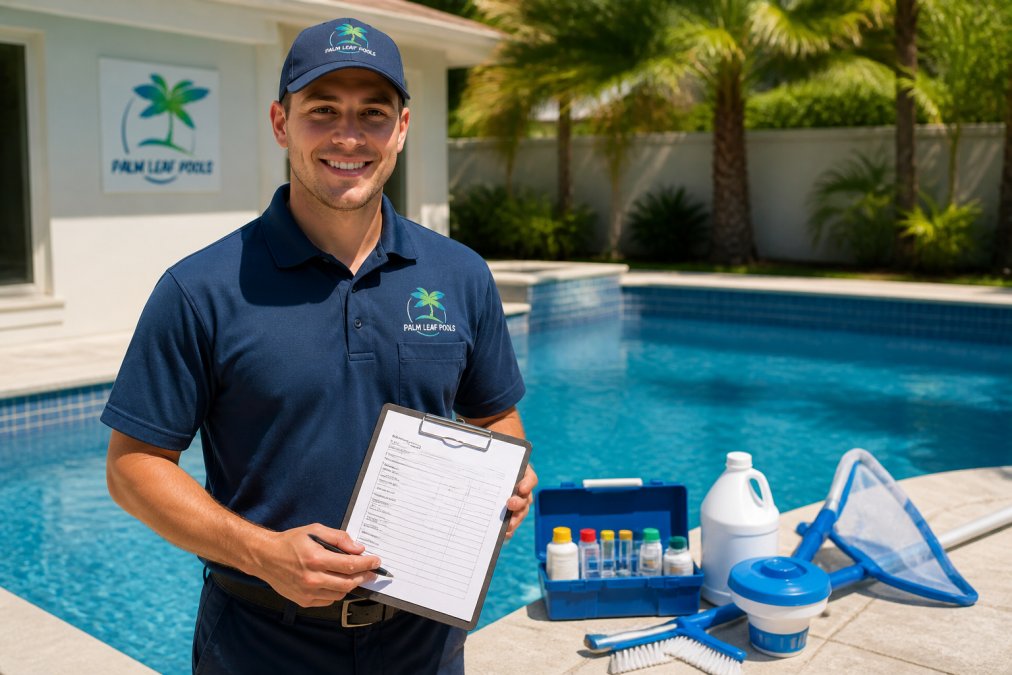
A pool service visit report documents work done and provides proof of service with specific data, visuals, and actionable information.
Essential Report Elements
Setting Clear Expectations for Response Times and Updates
Response time is how quickly your service provider answers your calls, texts, or emails. The tone, channel, and clarity matter just as much.
Defining Response Time Standards
Non-Emergency Messages
- Definition: Questions about routine maintenance, billing, scheduling, or general advice
- Expected response time: Within 24 business hours
- Acceptable channels: Email, text, or phone
Urgent Requests
- Definition: Equipment failure affecting pool safety or water quality
- Expected response time: Within 4-6 business hours
- Acceptable channels: Phone call or text
Emergency Situations
- Definition: Safety hazards or complete system failure
- Expected response time: Same day, within 2 hours
- Acceptable channels: Phone call only
Digital Communication Etiquette
Text Messages
- Use for confirmations, quick updates, and appointment reminders
- Avoid text for complex explanations or bad news
- Good: "Running 15 minutes late to your 2 PM appointment."
- Poor: "Pump broken. Costs $1,200."
- Use for detailed explanations, cost estimates, and documentation
- Include specific numbers, photos, and recommendations
- Use clear subject lines (e.g., "Service Visit Report - September 25")
Phone Calls
- Use for urgent issues, complex problems, or when tone matters
- Schedule calls in advance when possible
Automated Notifications
- Ask whether your service provider uses automated appointment reminders
- Clarify whether you want SMS, email, or both
- Request that messages include the technician's name and estimated arrival time
Proactive Communication Standards
Appointment Confirmation
- Sent 24 hours before the scheduled visit
- Includes: Date, time, technician name, and what will be done
Arrival Notification
- Sent when the technician is en route
- Includes: Estimated arrival time (within 15-minute window)
Service Completion Update
- Sent immediately after the visit
- Includes: What was done, any problems found, and next steps
Alert for Upcoming Issues
- Sent when the technician notices something needing attention soon
- Includes: What the issue is, why it matters, and timeline for action
Handling Common Communication Failures
Scenario: Technician Misses an Appointment
Good response:
- Technician calls or texts at least 2 hours before the scheduled time
- Explains the reason (traffic, emergency call, equipment failure)
- Offers a specific alternative time that same day or next day
- Apologizes and explains what will be done to prevent it next time
- Example: "Hi [Name], I'm so sorry, I had an emergency call come in and I'm running behind. I can't make your 2 PM appointment today. Can I reschedule for tomorrow at 10 AM instead? I apologize for the inconvenience."
Scenario: Unexpected Repair Cost
Good response:
- Technician stops work and calls you immediately
- Explains what the problem is in plain language
- Provides a written estimate with the cost and timeline
- Explains what happens if you don't fix it (e.g., "If we don't replace the pump now, it will fail in 2-4 weeks, and emergency replacement costs 30% more")
- Gives you 24 hours to decide before proceeding
- Example: "Hi [Name], I found something during today's service. Your pump bearing is making a grinding noise, which means it's wearing out. I can replace it for $950 in parts and labor. If we wait, the pump will fail completely, and emergency replacement will cost about $1,200. Can I send you a detailed estimate? You have until tomorrow to decide."
Scenario: Technician Finds a Problem You Disagree With
Good response:
- Technician sends a photo of the problem
- Explains the technical reason it's failing (not just "it's old")
- Provides a written estimate with options (e.g., "Option A: Replace now for $X. Option B: Monitor and replace in 6 months for $Y. Option C: Continue as-is and risk failure for $Z emergency cost")
- Offers a second opinion from another technician if you're unsure
- Example: "I found corrosion on the filter valve. See the attached photo. Corrosion restricts water flow and reduces filter efficiency. We have three options: (1) Replace the valve now for $350, (2) I can monitor it monthly and we'll replace when it fails completely (estimated 4-6 months, cost $500 emergency), or (3) continue as-is. What works best for you?"
Creating a Communication Agreement
- Response time for non-emergency messages: _____ hours
- Response time for urgent requests: _____ hours
- Preferred contact method: ☐ Text ☐ Email ☐ Phone
- Backup contact method: ___________
- Will you send appointment reminders? ☐ Yes ☐ No (If yes, how far in advance? _____)
- Will you send a service report after each visit? ☐ Yes ☐ No
- Will you include photos in service reports? ☐ Yes ☐ No
- For repairs over $500, will you call before charging? ☐ Yes ☐ No
Building Trust Through Transparency and Documentation
Trust is earned through consistent, honest communication and documentation. Transparency means explaining why chemicals are needed, showing actual test results, admitting problems, being honest about costs, and explaining the difference between routine maintenance and repairs. Documentation protects both parties and eliminates confusion about promises and completed work.
Frequently Asked Questions
What should a professional pool service report include after every visit?
A comprehensive pool service visit report template should document water chemistry readings (pH, chlorine, alkalinity), equipment inspection results, any repairs or recommendations made, work completed that day, and next service date. The report should include the technician's name, date, time of service, and clear notes on water clarity and any issues found. Digital reports with photos or visual documentation build trust and create an accurate record of your pool's condition over time.
How often should a pool be serviced to maintain proper water chemistry and equipment function?
Most residential pools require weekly service visits to maintain proper chemical balance, filter function, and equipment operation. However, the ideal frequency depends on your pool size, usage level, and climate. New pool owners should discuss their specific needs during onboarding to establish a maintenance schedule that protects their investment. Your service provider should explain why a particular frequency is recommended for your pool.
What key questions should I ask pool maintenance companies before hiring them?
Ask about their service frequency, what's included in their scope of work, how they communicate updates, their response time for emergencies, and whether they provide written service reports after each visit. Request their service agreement terms in writing and clarify billing transparency, ask if additional charges might arise during service. Ask for references and inquire how they handle equipment repairs or major issues discovered during routine maintenance.
How can I verify my pool maintenance company is actually providing quality service?
Review your pool service visit report template after each visit, it should document specific chemical readings, equipment checks, and work performed. Monitor your water clarity week to week; consistent clarity indicates proper maintenance. Compare your service logs over time to spot patterns. Ask your technician to explain findings and recommendations in detail. A professional company welcomes questions about their work and provides transparent documentation standards so you can verify service consistency.