 How-to
Why Is Pool Water Cloudy After Heavy Rain?
Last Updated: November 17, 2026
Quick Summary
Heavy rain usually makes pool water cloudy after rain because storms dilute sanitizer, wash in dust, pollen, and runoff, and overload the filter. The cloudiness is a symptom of rain-driven chemistry changes and particles the filter has not yet caught, so checking chlorine, pH, and the filter is the fastest fix.
- Test free chlorine and pH first, since dilution lowers sanitizer and lets algae start.
- Aim for free chlorine of 3 to 5 ppm during the first 48 hours after a storm.
- Milky white haze with normal chlorine usually points to filtration, not chemistry.
- Compare filter pressure to baseline; a rise of 8 to 10 psi means the filter is restricted.
- Avoid adding clarifier before finding the cause, since it can glue silt to the filter media.
Table of Contents
- Why Heavy Rain Turns Pool Water Cloudy
- Diagnosing the Cause: Rain Dilution, Runoff, Algae, or Filtration
- Testing Your Water: Target Ranges and Retest Schedule
- How to Clear Cloudy Pool Water Fast
- Pool Cloudy After Shock: Why It Happens and What to Do
- When a Pool Clarifier Helps and When Filtration Is the Real Problem
- Is It Safe to Swim in a Pool After Rain?
- Booking Help for a Storm-Damaged or Neglected Pool
- Frequently Asked Questions
Why Heavy Rain Turns Pool Water Cloudy
Heavy rain is one of the most common reasons a healthy-looking pool suddenly turns murky overnight. This is common after big storms, and the cause is usually less mysterious than it looks. Storms dilute your chemistry, wash contaminants in, and load your filter with more work than it was built for. Knowing what is happening makes the fix faster.
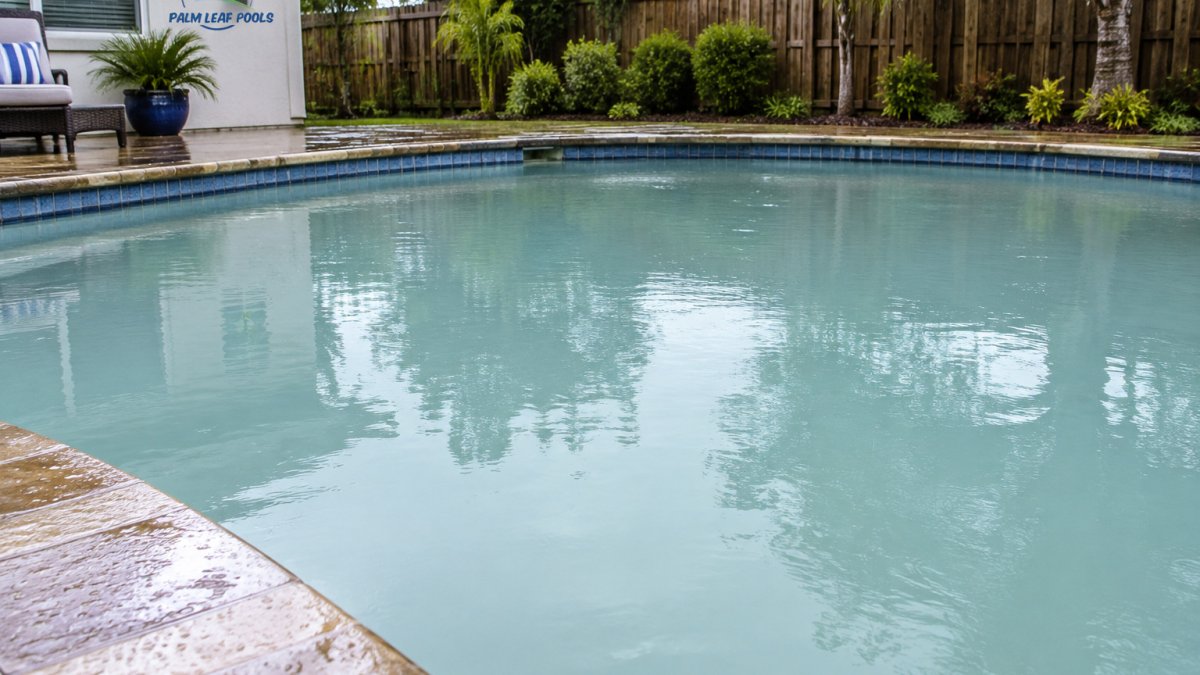
Cloudy after rain is the most common symptom homeowners report after a storm. The water looks milky or hazy because tiny particles are suspended in it, too small to settle and too numerous for the filter to catch right away.
Rainwater dilution and chemistry changes
Rain is mostly water, and it has very little chlorine. When a heavy storm drops several inches of rain into your pool, your sanitizer level drops with it. Free chlorine can fall quickly, which gives algae and bacteria room to start growing.
Rain also shifts your pH and alkalinity. Those numbers are often off after a storm, and an unbalanced pool loses sanitizer faster. Your water may look cloudy simply because the chemistry is out of balance.
Check these levels before you add anything. You can read more about keeping your water balanced in our guide to [maintaining pool water chemistry | palmleafpools.com].
Dust, pollen, runoff, and storm debris
Storms bring more than water. Wind pushes dust and pollen into the pool, and rain washes soil, grass clippings, and fine sediment off the deck and yard. A lot of this material is too small to see at first, but it turns the water cloudy once it is suspended.
Leaves and twigs add to the problem. They break down in the water, releasing tannins that can tint the pool a brownish or yellow color. Runoff from nearby landscaping can also carry fertilizer, which feeds algae.
Diagnosing the Cause: Rain Dilution, Runoff, Algae, or Filtration
Not every cloudy pool has the same cause, and the wrong fix wastes time and chemicals.
Step 1: Test free chlorine and pH first. Everything downstream depends on these two numbers. If free chlorine is below 1 ppm or pH is outside 7.2 to 7.8, treat dilution and balance before you look at anything else. A pool that lost sanitizer to several inches of rain will usually look milky and hazy, not green, because algae has not had time to bloom yet.
Step 2: Look at the color and clarity. Color is the cheapest diagnostic you have.
- Milky white or light blue haze with normal chlorine: Fine suspended particles, usually silt, pollen, or dead organic matter the filter cannot catch yet. This points to filtration, not chemistry.
- Green or greenish tint: Algae. Sanitizer dropped low enough for a bloom to start, which is common 24 to 72 hours after a storm.
- Brown, yellow, or tea-colored water: Tannins from leaves and runoff, or soil and mulch washed in from the yard. This is a contaminant problem, not a chlorine problem.
- Gray or dull water with a strong chlorine smell: Combined chloramines from heavy organic load. The pool needs oxidation (shocking), not more stabilizer.
Step 3: Check filter pressure and flow. Compare the current pressure gauge reading to the clean-filter baseline you recorded after the last cleaning.
Step 4: Rule out runoff. Walk the deck and the yard after the storm.
Watch out: adding clarifier or flocculant before you know the cause can glue fine silt to the filter media and make the haze worse, so finish the diagnosis before you treat.
Water color is the quickest clue to the cause, so match what you see against the common patterns below.
| Water appearance | Likely cause | Next step |
|---|---|---|
| Milky white or light blue haze, normal chlorine | Fine silt, pollen, dead organic matter | Check filter, not chemistry |
| Green or greenish tint | Algae after sanitizer dropped | Shock and filter; check chlorine |
| Brown, yellow, or tea-colored | Tannins from leaves, runoff soil | Remove contaminants and debris |
| Gray or dull, strong chlorine smell | Combined chloramines from organic load | Oxidize (shock), do not add stabilizer |
Testing Your Water: Target Ranges and Retest Schedule
Test before you treat, and test more than once. A basic test kit or test strips will tell you what the water needs, but the ranges below are the ones that matter after a storm, and the retest schedule is what keeps you from overcorrecting.
Aim for these general residential ranges:
- Free chlorine: 1 to 3 ppm for most residential pools; 3 to 5 ppm is a safer target for the first 48 hours after a storm.
- Combined chlorine (chloramines): 0.5 ppm or less. A reading above that means the pool needs oxidation, not more chlorine.
- pH: 7.4 to 7.6.
- Total alkalinity: 80 to 120 ppm.
- Calcium hardness: 200 to 400 ppm for plaster pools; lower is acceptable for vinyl and fiberglass.
- Cyanuric acid (stabilizer): 30 to 50 ppm. This is the number most homeowners skip, and it matters after rain because dilution lowers it along with chlorine. If stabilizer falls below about 30 ppm, chlorine burns off faster in sunlight and the pool will not hold a sanitizer level.
Retest schedule. Test free chlorine and pH daily for the first three days after a heavy storm, then return to your normal weekly schedule once the water is clear and the numbers are stable. Retest any parameter 24 hours after you adjust it, because a single dose rarely lands exactly on target and heavy rain can dilute the water again before the adjustment fully takes effect. Test cyanuric acid monthly, or after any storm that added more than a few inches of water.
How to read the results together. A pool with normal free chlorine but low stabilizer will lose chlorine within a day, so fix stabilizer before you chase a chlorine reading.
Watch out: test strips lose accuracy in the days after a storm because fine silt can tint the pad, so confirm any borderline reading with a liquid kit before you dose the pool.
How to Clear Cloudy Pool Water Fast
Work through these steps in order. Skipping ahead often makes the problem last longer.
- Remove debris. Skim leaves and sticks from the surface and empty the skimmer and pump baskets.
- Brush the walls and floor. Loosened particles settle, so the filter can catch them.
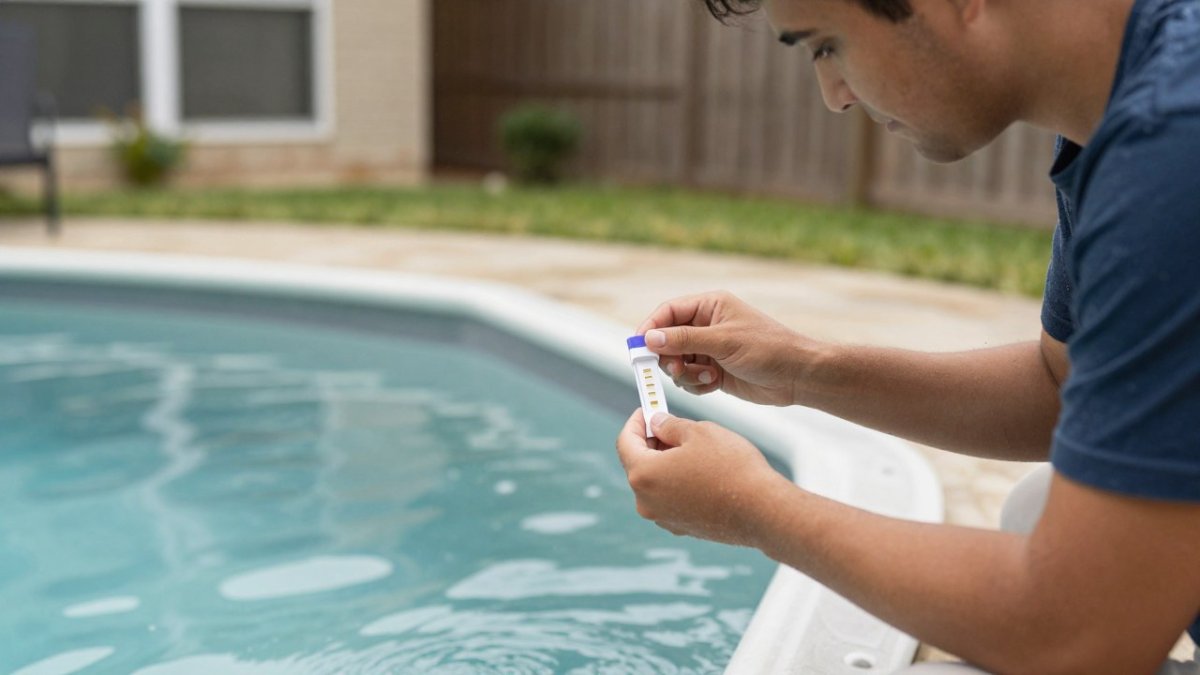
- Test the water. Check chlorine, pH, and alkalinity before adding anything.
- Adjust pH and alkalinity. Bring them into range first so the sanitizer works well.
- Shock the pool. Add a shock product to raise free chlorine to a level that kills algae and bacteria.
- Run the filter. Keep the pump running 24 hours a day until the water clears, then go back to a normal schedule.
- Clean or backwash the filter. A clogged filter cannot remove fine particles, so clean it when pressure rises.
- Add a clarifier if needed. Use this for stubborn haze after the chemistry is right.
For the full sequence, see our guide on [how to tell how long pool shock takes to work | palmleafpools.com].
Calculating chemical adjustments for rainfall and pool volume
Chemical doses depend on how much water your pool holds. A common approach is to estimate pool volume first, then dose from the product label. A 20,000-gallon pool needs far more shock than a 10,000-gallon pool.
To estimate volume, multiply the average length, width, and depth in feet, then multiply by 7.5 to get gallons. Use the product label to convert that volume into the correct amount of shock or adjuster. Retest afterward, since heavy rain can dilute the water again before the adjustments fully take effect.
Pool Cloudy After Shock: Why It Happens and What to Do
Sometimes the water gets cloudier after you shock it. This is normal in many cases. Shock burns off organic material, and the dead matter can look hazy for a day or two before the filter removes it.
Give the pump time to work, and keep the filter clean. If the water stays cloudy after 48 to 72 hours, retest the chemistry and check whether the filter is restricted. A clarifier can help gather the fine particles so the filter can catch them. For more detail, read [how to know when it's safe to swim after shocking a pool | palmleafpools.com].
When a Pool Clarifier Helps and When Filtration Is the Real Problem
A clarifier works by making fine particles clump together so the filter can trap them. It helps when the chemistry is balanced but the water still looks hazy. It does not fix bad chemistry or a broken filter.
Use a clarifier when the water is balanced and the filter is clean but the haze remains. If the water does not clear after a clarifier and a full day of filtration, the filter itself may be undersized, damaged, or running too few hours.
Is It Safe to Swim in a Pool After Rain?
Usually, yes, once the chemistry is in range. Rain lowers sanitizer levels, so test free chlorine before anyone gets in. Wait until chlorine is back in the safe range and the water is clear enough to see the drain at the bottom.
Avoid swimming after a severe storm if floodwater has entered the pool or the yard. Floodwater can carry bacteria and contaminants, and it may take several rounds of shocking and filtering before the water is safe. When in doubt, call a professional.
Booking Help for a Storm-Damaged or Neglected Pool
Some pools need more than a few chemical adjustments. If your water stays cloudy after a full round of DIY fixes, or if the pool has been neglected for months, a professional cleaning may be the fastest path back to clear water. Palm Leaf Pools provides weekly maintenance and complete remodeling services. Call Today! to discuss what your pool needs.
Frequently Asked Questions
Why did my pool turn cloudy after rain?
Heavy rain dilutes the pool's chlorine and shifts pH and alkalinity, which can leave particles suspended in the water. Rainstorms also wash dust, pollen, soil, and leaves into the pool and can overwhelm the filter. Test free chlorine, pH, and alkalinity first, then run the filter continuously until the water clears. If the cloudiness persists after testing and adjusting, the cause may be algae or a filtration problem that needs a closer look.
Will shock fix a cloudy pool after rain?
Shocking can help if free chlorine is low, because it raises sanitizer levels enough to oxidize contaminants and kill bacteria. However, shocking alone will not fix cloudiness caused by a clogged filter, high pH, or suspended particles. Pool cloudy after shock is often a sign that the filter is not removing debris fast enough. Brush the walls and floor, run the pump for 24 to 48 hours, and clean or backwash the filter before shocking again if needed.
Is it safe to swim in a pool after rain?
Swimming is generally safe once free chlorine is within the recommended range, typically 1 to 3 parts per million, and pH is between 7.2 and 7.8. Water that is cloudy or has visible debris should be cleared first. Avoid swimming in a pool after a storm that flooded it with runoff or contaminated floodwater, and do not swim if the water shows signs of algae or an unusual odor. Check local health department guidance if the pool was affected by flooding.
How long does it take for a cloudy pool to clear after rain?
Most pools clear within 24 to 72 hours once chemistry is corrected and the filter runs continuously. Retest free chlorine, pH, and alkalinity every 12 to 24 hours during recovery. If the water has not improved after three days of consistent filtration and testing, the filter may need cleaning or the problem may be algae or a clarifier-level issue.