 ultimate-guide
Cost of Weekly Pool Maintenance Services: 2026 Guide
Table of Contents
- What Is Included in Weekly Pool Service
- Factors Affecting Pool Service Pricing
- Average Monthly Cost of Weekly Pool Maintenance
- Service Frequency: Weekly vs. Bi-Weekly Maintenance
- Hidden Costs of Weekly Pool Maintenance
- Saltwater vs. Chlorine Pool Maintenance Costs
- How to Choose a Reliable Pool Service Company
- Frequently Asked Questions
Last Updated: September 20, 2026
What Is Included in Weekly Pool Service
Weekly pool maintenance is a scheduled service visit in which a trained technician cleans, tests, and chemically balances a residential pool to keep water safe and equipment protected. The cost of weekly pool maintenance services reflects the labor, chemicals, and travel bundled into that recurring visit, which is why two quotes for the same pool can differ by a wide margin.
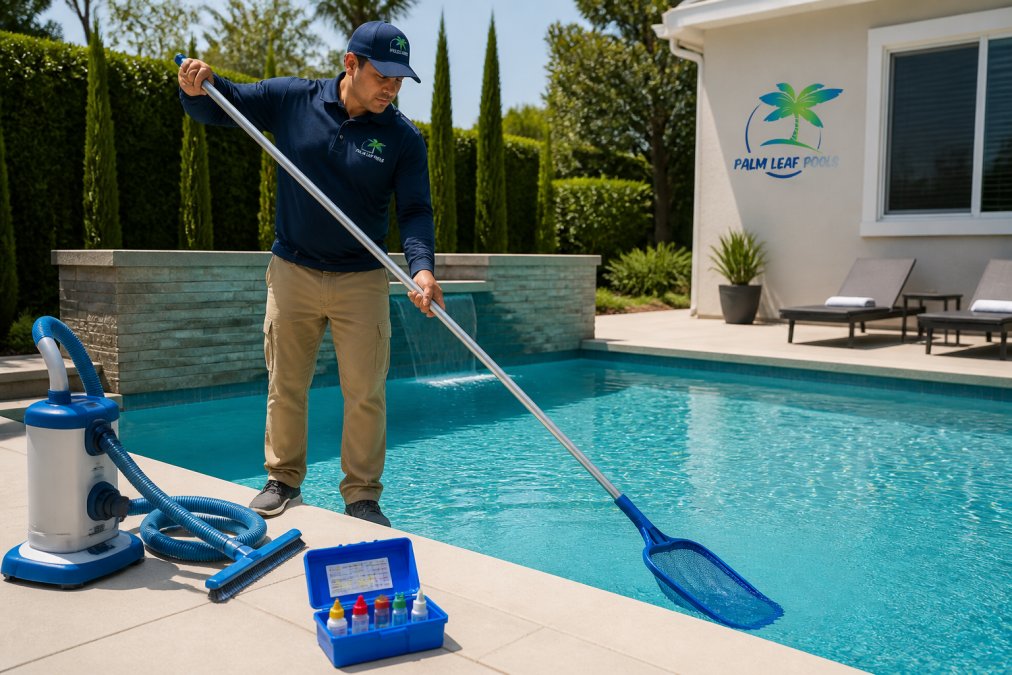
The Standard Weekly Visit Checklist
A standard weekly visit covers surface cleaning, water testing, chemical adjustment, and equipment inspection. Most full-service plans include:
- Skimming leaves, insects, and surface debris
- Brushing walls, steps, and the waterline tile
- Vacuuming the floor or running an automatic cleaner
- Emptying skimmer and pump baskets
- Testing pH, alkalinity, and sanitizer levels
- Adding balancing chemicals and sanitizer as needed
- A visual check of the pump, filter, and heater
Factors Affecting Pool Service Pricing
Pricing depends on pool volume, debris load, water chemistry stability, and how far the technician travels to reach the property. A 15,000-gallon pool with light leaf fall needs less work per visit than a 40,000-gallon pool ringed by trees.
Pool Size, Gallon Capacity, and Water Chemistry
Pool size drives both labor time and chemical volume. Larger gallon capacity requires more sanitizer to reach the same concentration, and more surface area to brush and vacuum. Water chemistry adds a second variable: a pool that holds pH and alkalinity steady week to week is faster to service than one that swings constantly after rain or heavy use. Pools with persistent algae, scale, or cloudy water take longer per visit until the water stabilizes.
| Pricing Factor | Effect on Cost | Why It Matters |
|---|---|---|
| Pool size and gallon capacity | Higher | More chemical volume and labor time |
| Debris load | Higher | More skimming, vacuuming, basket cleaning |
| Water chemistry stability | Higher when unstable | Extra testing and correction time |
| Filter type | Varies | Backwashing and cleaning add visit time |
| Travel distance | Higher | Fuel and routing time built into rate |
| Chemicals included or not | Higher if included | Sanitizer and balancing products billed separately otherwise |
Average Monthly Cost of Weekly Pool Maintenance
Most homeowners want one number, but weekly pool service is not sold that way. The honest answer is a range, and the range is set by three variables: your market, your pool, and which service tier you buy. Understanding the tiers is what turns a vague quote into a comparable price.
The Three Service Tiers
Almost every weekly plan on the market falls into one of three tiers, and the gap between them is larger than the gap between companies selling the same tier.
| Tier | What the Technician Does | Typical Monthly Range |
|---|---|---|
| Chemical-only | Tests water, adds sanitizer and balancing chemicals, empties skimmer basket | Lowest tier |
| Full service | Everything in chemical-only plus skimming, brushing, vacuuming, and basket cleaning | Mid tier |
| Full service plus | Full service plus filter cleaning, equipment inspection reports, and priority repair scheduling | Highest tier |
Contract vs. On-Demand Pricing
Weekly service is usually sold one of two ways, and the billing model changes the effective rate:
- Flat-rate monthly contract. You pay the same amount each month regardless of how many visits fall in that month. This smooths your budget and usually locks in a lower per-visit rate, but it typically carries a term, often month-to-month with notice, sometimes a seasonal commitment.
- Per-visit pricing. You pay for each visit as it happens. There is no term and no commitment, but the per-visit rate is higher than the contracted rate, and there is no guarantee the same technician returns.
What Actually Moves the Number
Within a single tier, four factors push the monthly rate up or down:
- Pool volume. A 15,000-gallon pool needs less sanitizer per visit than a 40,000-gallon pool to reach the same concentration, and less surface to brush and vacuum.
- Debris load. A pool ringed by trees can double the skimming and vacuuming time of a pool on an open lot.
- Water chemistry stability. A pool that holds pH and alkalinity steady is faster to service than one that swings after every rain or heavy swim day.
- Travel and route density. A company with several pools on your street can service you cheaper than one driving across the metro for a single stop.
Why We Quote Instead of Publishing a Flat Rate
Because pricing varies so widely by market, pool size, and debris exposure, we recommend requesting a written quote based on your specific pool rather than relying on a single national figure. Palm Leaf Pools provides custom quotes for weekly pool maintenance after assessing your pool's size, equipment, and debris exposure, and the quote breaks out which tier you are buying and whether chemicals are bundled.
Service Frequency: Weekly vs. Bi-Weekly Maintenance
Weekly service suits most residential pools. Bi-weekly maintenance can work for small, covered, lightly used pools, but it leaves more time for sanitizer to drop and debris to accumulate between visits. In a warm climate with year-round swimming, the gap between bi-weekly visits is usually long enough for water quality to slip.
| Service Frequency | Best For | Trade-Off |
|---|---|---|
| Weekly service | Most residential pools, year-round use | Higher monthly cost, steadier water |
| Bi-weekly maintenance | Small covered pools, low use, seasonal | Lower cost, more chemical swings |
| On-demand visits | Rental properties, occasional use | No schedule, pay per visit |
Hidden Costs of Weekly Pool Maintenance
Hidden costs surface when a plan excludes items the homeowner assumed were covered. The four most common are chemicals, filter cleaning, equipment repairs, and green-pool recovery, but the biggest hidden cost of all is the one almost no guide discusses: the lifecycle cost of the equipment your weekly contract does not cover.
The Four Recurring Exclusions
- Chemicals: Sanitizer, shock, algaecide, and balancing products are frequently billed separately from the base rate. On a chemical-only plan, this is the entire cost of the service.
- Filter cleaning: DE and cartridge filters need periodic deep cleaning beyond routine backwashing. A DE filter that needs breaking down and recharging adds a line item a cartridge filter does not.
- Equipment repairs: A failed pump, heater, or salt cell is a separate job from maintenance. Weekly service keeps water balanced; it does not prevent mechanical failure.
- Green-pool recovery: Restoring an algae-bloomed pool takes multiple visits and heavy chemical treatment, not a standard weekly visit. It is priced as a project, not a visit.
The Lifecycle Cost Nobody Quotes
A weekly maintenance contract covers labor and water chemistry. It does not cover the pump, filter, heater, salt cell, or automation that keep the pool running. Those components have finite service lives, and when they fail, the replacement is a capital expense, not a maintenance line item.
Seasonal and Inflation Adjustments
Weekly service pricing is not static across the calendar. Two forces move it:
- Peak-season demand. In warm months, when every pool in the neighborhood needs service and technicians are booked out, rates and chemical costs both climb. Some companies apply a seasonal surcharge or a higher summer rate.
- Winterization periods. In markets with a cold season, weekly service may pause or drop to a monthly check, and the annual cost is concentrated into the swimming months rather than spread evenly.
How to Compare Plans on Total Cost
Add four numbers before you sign: the monthly base rate, the average monthly chemical spend, the expected annual filter-cleaning cost, and a realistic reserve for equipment replacement. The plan with the lowest base rate is rarely the plan with the lowest total cost.
Saltwater vs. Chlorine Pool Maintenance Costs
Saltwater pools are not chemical-free. A salt cell generates chlorine from dissolved salt, so the pool still needs sanitizer management, pH control, and periodic cell cleaning. Chlorine pools require manually added sanitizer. The running cost difference comes down to salt cell replacement and electricity versus the ongoing purchase of chlorine products.
| Pool Type | Ongoing Cost Pattern | Key Maintenance Note |
|---|---|---|
| Chlorine pool | Steady chemical purchases | Sanitizer added manually each visit |
| Saltwater pool | Lower chemical purchases, higher equipment cost | Salt cell cleaning and eventual replacement |
How to Choose a Reliable Pool Service Company
Choose a company that documents its scope, communicates proactively, and stands behind its work. Reliability is the quality homeowners ask about most, and it shows up in the details: a written service checklist, a named technician, and a clear process for reporting problems found during a visit.
Ask these questions before signing:
- Does the quoted rate include chemicals, or are they billed separately?
- What exactly happens on each weekly visit?
- How do you notify me if you find an equipment problem?
- Is there a contract term, or can I cancel with notice?
- Are repairs quoted and approved before work begins?
- Do you provide updates after each visit?
Frequently Asked Questions
Is weekly pool service worth it?
For most homeowners, yes. Weekly pool maintenance keeps water chemistry balanced, which prevents algae blooms and equipment damage that cost far more to fix than routine service. A technician handles chemical balancing, skimming, vacuuming, brushing, and filter checks in one visit. If you travel often or have a large pool, weekly service is usually the cheapest way to protect your investment.
How much should I budget for weekly pool maintenance services?
Budgeting depends on your pool's gallon capacity, service frequency, and whether chemicals are included. Most plans bill monthly, and the final price reflects pool size, debris load, and add-ons like filter cleaning. Request a quote based on your specific pool so you get an accurate number instead of a generic estimate.
What is typically included in a standard weekly pool maintenance package?
A standard visit covers skimming, vacuuming, brushing walls and tiles, emptying baskets, water testing, and chemical balancing. Filter cleaning and equipment inspections may be included or billed separately. Ask each company exactly what is included in weekly pool service before signing, since chemical costs and filter cleaning are the two most common exclusions.
Does pool size affect the cost of weekly cleaning services?
Yes. Larger pools hold more gallons, which means more chemicals per visit and more time to vacuum, skim, and brush. A 30,000-gallon pool typically costs more to maintain than a 12,000-gallon pool on the same schedule. Gallon capacity, not just surface area, is the number most pool service companies use when quoting weekly maintenance.
Aging pools, heavy debris seasons, and inconsistent chemistry turn a simple weekly visit into an unpredictable expense. Palm Leaf Pools removes that uncertainty with dependable weekly pool maintenance, complete pool remodeling services, and constant communication so you always know what was done and what it cost. Get started with Palm Leaf Pools and keep your pool clean, safe, and beautiful year-round. Call today.