 ultimate-guide
Book Weekly Pool Cleaning Service: What to Expect
Table of Contents
- What Is Included in Weekly Pool Maintenance
- Average Monthly Cost for Pool Service
- How to Choose a Pool Maintenance Company
- DIY vs. Professional Pool Cleaning: Which Costs Less?
- How Seasonal Changes Affect Your Weekly Pool Cleaning Service
- Equipment Troubleshooting: When to Call a Pro
- Eco-Friendly Chemicals and Sustainable Pool Care
- Frequently Asked Questions
Last Updated: September 14, 2026
What Is Included in Weekly Pool Maintenance
Booking a weekly pool cleaning service means a trained technician handles the full cycle of pool care on a set schedule: skimming, vacuuming, brushing, emptying baskets, testing and balancing water chemistry, and inspecting equipment. You just swim.
This guide from Palm Leaf Pools breaks down what each visit covers, what drives the monthly price, and how to tell a reliable provider from one that disappears after two weeks.
That matters more than most homeowners realize: a neglected pool doesn't just get dirty, it drifts out of chemical balance, and that drift turns a clear pool green.
Core Tasks Every Visit Covers
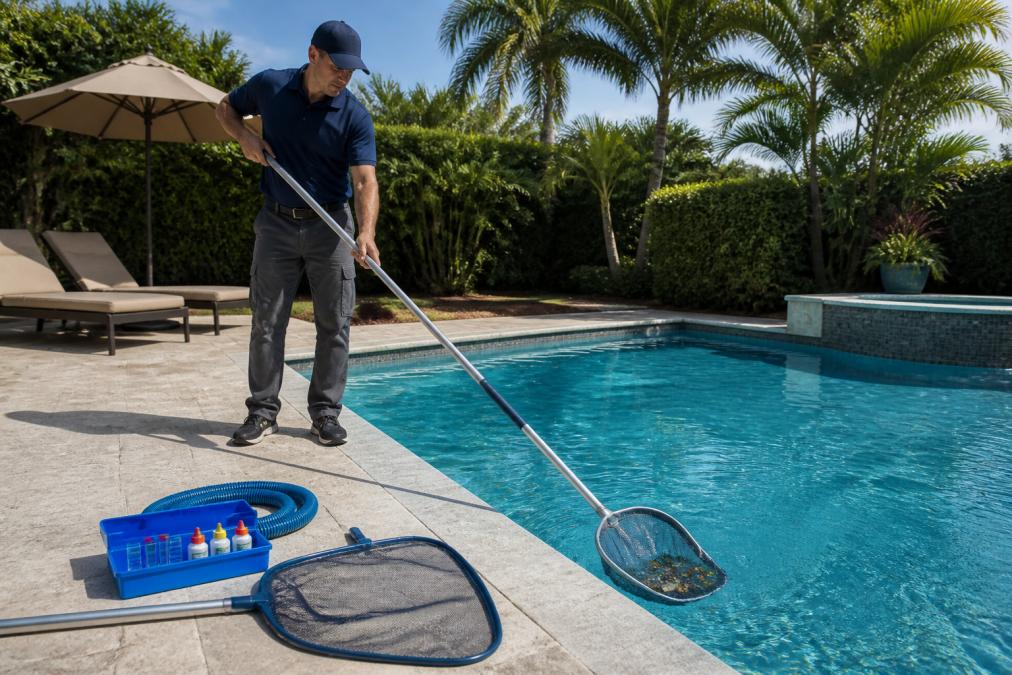
A standard weekly visit covers the physical work that keeps water clear and equipment running:
- Skimming the surface for leaves, insects, and floating debris
- Brushing walls, steps, and the waterline tile to break up algae before it attaches
- Vacuuming the floor of the pool, or checking that an automatic cleaner is running correctly
- Emptying the skimmer and pump baskets before they restrict flow
- Cleaning the filter as needed, whether that's a backwash, a cartridge rinse, or a grid check
- Inspecting the pump, filter, heater, and valves for leaks, noise, or pressure changes
Water Chemistry and Safety Checks
Water chemistry is the practice of testing and adjusting the minerals and sanitizers in your pool so the water stays safe to swim in and gentle on surfaces. A weekly visit typically tests and corrects:
| Parameter | What It Controls | Why It Matters |
|---|---|---|
| pH balance | Acidity vs. alkalinity of water | Off-balance pH stings eyes and corrodes fittings |
| Total alkalinity | pH stability buffer | Low alkalinity makes pH swing daily |
| Calcium hardness | Mineral content | Too low etches plaster, too high clouds water |
| Chlorine levels | Sanitization | Kills bacteria and prevents algae |
| Cyanuric acid | Sunscreen for chlorine | Protects sanitizer from UV breakdown |
A good technician logs these readings every visit. A saltwater system still produces chlorine, so the same testing applies. Ask for the numbers in writing, not a verbal "it's fine."
Average Monthly Cost for Pool Service
Average monthly cost for pool service in the U.S. typically lands between roughly $80 and $200 per month for a standard residential pool on a weekly plan, with chemicals either bundled or billed separately (angi.com). That range is wide because the inputs vary, but it's the one to hold in your head when quotes arrive.
Here's how the pieces usually break down on a weekly plan:
| Line Item | Typical Monthly Range | Notes |
|---|---|---|
| Weekly labor (4 visits) | $60-$140 | Higher in high-cost metros, lower in rural markets |
| Chemicals (if included) | $30-$80 | Chlorine, acid, shock, stabilizer, algaecide |
| Filter cleaning / backwash | $0-$25 amortized | Some plans include, some bill per occurrence |
| Equipment inspection | Usually included | Should be part of every visit |
| Salt cell cleaning (salt pools) | $0-$20 amortized | Quarterly, not weekly |
A screened, lightly used pool in a mild climate sits at the low end; a tree-lined pool with heavy leaf load, large surface area, or a salt system sits at the high end.
What Drives Your Monthly Price Up or Down
Several factors move the number:
- Pool size and shape. More surface area means more brushing, vacuuming, and chemicals. A 30,000-gallon pool costs meaningfully more than a 12,000-gallon one (homeadvisor.com).
- Debris load. Trees, nearby construction, and open lots all increase weekly labor. A pool under a live oak is a different job than one in a screened lanai.
- Service frequency. Weekly visits cost more per month than bi-weekly, but they prevent the expensive problems monthly-only service creates. A monthly-only pool often needs a recovery visit before every service.
- Chemicals included or not. Bundled is usually cheaper overall, but only if the provider actually doses what the pool needs rather than rationing.
- Equipment condition. An aging pool pump or a filter that needs replacement adds labor and parts. A pump running hot or a filter short-cycling will show up on the invoice eventually.
- Green pool recovery. A pool that's already turned green often requires a separate recovery process before routine service can begin.
- Local labor market. Two identical pools in different metros can differ by 40% or more on labor alone.
What to Ask About the Price
Before comparing quotes, make sure they cover the same thing:
- Is the price per month or per visit?
- Are chemicals included, and is there a cap on how much chemical is included?
- Is there a separate charge for filter cleaning, backwashing, or salt cell cleaning?
- What's the price for a green-to-clean recovery, and is it waived if you sign a weekly plan?
- Is there a contract, and what's the cancellation notice?
Two quotes that look $40 apart often aren't, once chemicals and filter service are added back in.
How to Choose a Pool Maintenance Company
The best way to choose a pool maintenance company is to test three things before you sign: whether they show up on schedule, communicate proactively, and can explain what they're doing in plain language. Reliability is the entire product, a brilliant technician who skips weeks is worse than an average one who never misses.
The harder question is how you verify those three things before you've paid anyone.
Verify Before You Sign, Not After
Any provider can claim to be licensed, insured, and reliable. A few minutes of checking separates the real ones from the rest:
- License and insurance. Ask for proof of license and insurance. Verifying these credentials helps ensure you are working with a legitimate and responsible provider.
- Business registration. A quick search of your state's business registry confirms the company exists as a legal entity and who's behind it.
- Reviews across platforms. Check Google, Yelp, and the Better Business Bureau together. A single 5-star profile with no history elsewhere is a weaker signal than a mixed but long-running one.
- References from pools like yours. Ask for two or three customers with a similar pool size and debris load. A provider who only has references from tiny screened pools may not be set up for a tree-lined 30,000-gallon job.
Questions to Ask Before You Book
Run through this checklist before you commit:
- Are visits weekly, and what day? What happens if it rains?
- Are chemicals included, or billed separately? Is there a cap?
- Will I get a written report of water chemistry after each visit?
- Who is my point of contact, and how fast do they respond?
- What happens if you find a serious problem during a cleaning? Do you call first before doing any work?
- Are you licensed and insured, and can you show proof?
- What's the cancellation policy?
That fifth question prevents a surprise bill: a trustworthy provider calls before performing any repair outside the routine visit.
Red Flags That Predict a Bad Experience
Patterns show up before the first invoice. Watch for these:
- No written service agreement. A verbal "we'll take care of it" is not a scope of work.
- Cash-only or no invoice. Makes it hard to dispute a charge or prove service was performed.
- No chemistry log. If they can't show you the numbers, they're guessing.
- Pressure to prepay for a year. Legitimate providers bill monthly or quarterly.
- Different technician every visit with no handoff. A rotating cast means nobody owns your pool's history.
- Quotes given without seeing the pool. Size, debris load, and equipment condition can't be assessed over the phone.
How to Run a 30-Day Trial
The lowest-risk way to choose a provider is to treat the first month as a trial with clear checkpoints:
- Week 1: Confirm the tech shows up on the promised day and leaves a written chemistry report.
- Week 2: Check that the report reflects real readings, not boilerplate. Ask a question about one of the numbers and see if the answer is specific.
- Week 3: Note whether the tech flags anything proactively (a slow leak, a pump running hot) or only reacts.
- Week 4: Compare the pool's clarity and the equipment's behavior to where it started.
If all four checkpoints pass, you've found a keeper. If any fail, you've lost a month, not a year.
DIY vs. Professional Pool Cleaning: Which Costs Less?
DIY pool cleaning costs less in direct outlay and more in time, and the gap narrows fast once you price your own hours. You buy test kits, chemicals, a vacuum, brushes, and a net, then spend an hour or more each week on the work, and absorb the cost of every mistake, which corrodes equipment, stains plaster, and turns pools green.
Professional weekly service trades that time and risk for a predictable monthly fee. For busy households, hiring out usually wins; for a retiree with a small, simple pool and time to learn the chemistry, DIY can genuinely work.
The honest dividing line isn't cost. It's whether you'll actually keep up with it every single week, including the weeks you're traveling, sick, or simply not in the mood.
How Seasonal Changes Affect Your Weekly Pool Cleaning Service
Pool care in a climate with real seasons looks nothing like pool care in a mild one. In hotter months, chlorine burns off faster, evaporation concentrates minerals, and algae grows aggressively (the CDC). Weekly visits become non-negotiable, and shock treatment may be needed after heavy use or a storm.
In cooler months, chemical demand drops, but the work doesn't stop. Debris still falls, equipment still needs inspection, and a pool left unattended through winter can develop staining or freeze damage. Year-round weekly service smooths out those swings. Instead of two frantic recovery jobs a year, you get small adjustments every week.
That's the argument for keeping service going through the off-season: the pool doesn't pause just because you do.
Equipment Troubleshooting: When to Call a Pro
Some issues you can handle yourself. Others need a technician before they become a replacement.
| Symptom | Likely Cause | DIY or Call a Pro |
|---|---|---|
| Cloudy water | Chemistry imbalance or filter issue | Test first, call if it persists |
| Weak return flow | Clogged basket or impeller | Check baskets, then call |
| Pump making grinding noise | Bearing or motor failure | Call a pro immediately |
| Visible algae patches | Sanitizer crash or circulation gap | Call for shock and diagnosis |
| Heater not firing | Ignition, gas, or flow sensor | Call a pro |
| Constant pressure drop | Filter media or plumbing leak | Call a pro |
The rule of thumb: if it involves electricity, gas, or opening sealed equipment, stop and call. Everything else is worth a look at the baskets and the test kit first.
Eco-Friendly Chemicals and Sustainable Pool Care
Sustainable pool care is less about exotic products and more about using fewer chemicals, more precisely. A balanced, properly circulating pool needs less sanitizer, less shock, and less water replacement.
Practical moves that reduce chemical load:
- Run the pump on a schedule matched to your pool's actual turnover needs rather than 24/7
- Keep cyanuric acid in range so chlorine isn't destroyed by sunlight before it works
- Fix small leaks promptly, since every leak means replacing water and rebalancing it
- Use a cover to cut evaporation and debris load
- Choose concentrated or reduced-phosphate products where they fit your pool
None of this requires a specialty label. It requires attention, which is exactly what weekly service provides.
Frequently Asked Questions
How much is weekly pool cleaning?
Weekly pool cleaning costs vary based on pool size, condition, and specific service requirements. Pricing depends on factors like debris load and chemical needs. Palm Leaf Pools provides custom quotes based on your specific pool, so you know exactly what's included before service starts. Request a quote to get your exact monthly rate.
Is weekly pool service worth it?
Weekly service prevents small issues from becoming expensive repairs. A technician tests pH balance, alkalinity, and chlorine levels every visit, catching problems before they turn your pool green or damage equipment. For busy homeowners who want consistent water clarity and safety, the cost of weekly service is often less than the cost of one major repair. It also protects your investment by keeping the pump, filter, and surfaces in good condition.
What is included in a standard weekly pool cleaning service?
A standard visit includes skimming surface debris, brushing walls and steps, vacuuming the floor, emptying skimmer and pump baskets, and testing water chemistry. The technician adjusts pH balance, alkalinity, calcium hardness, and chlorine levels as needed. They also inspect the pool equipment for signs of wear. Some providers include filter cleaning on a rotating schedule. Palm Leaf Pools communicates what was done and any issues found after each visit.
How many times a week should a pool be cleaned?
Most residential pools need one professional cleaning per week. Pools with heavy debris, high use, or no screen enclosure may benefit from twice-weekly visits. During summer months or after storms, extra service helps maintain water clarity and chemical balance. Your provider can recommend the right frequency based on your pool's environment and usage. Weekly service is the standard for year-round maintenance in most climates.
Pools punish neglect quietly and then all at once. The homeowners who avoid the green-water panic and the mid-summer equipment replacement aren't lucky, they're on a schedule. Palm Leaf Pools handles that schedule with weekly pool maintenance, complete remodeling services when your pool needs more than cleaning, and constant communication so you always know what's happening in your water. Get started with Palm Leaf Pools and let your pool stay swim-ready all year. Call Today!