 blog
Best Pool Cleaning Service Features to Look For
Table of Contents
- What Makes a Pool Cleaning Service Stand Out
- Weekly Pool Service Checklist: What Should Be Included
- Pool Chemical Testing and Balancing
- Equipment Inspection and Preventive Maintenance
- Questions to Ask a Pool Service Company Before Hiring
- Understanding Pool Cleaning Service Cost and Contract Terms
- Reliability, Communication, and Accountability
- Frequently Asked Questions
Last Updated: October 15, 2026
What Makes a Pool Cleaning Service Stand Out
A great pool cleaning service does far more than skim leaves and add chlorine. The best pool cleaning service features combine technical expertise, reliable communication, and a commitment to protecting your investment year-round.
We've worked with homeowners who thought all pool services were the same.
This guide breaks down the essential pool cleaning service features to expect, questions to ask before hiring, and how to evaluate whether a company will protect your pool.
Weekly Pool Service Checklist: What Should Be Included
Your weekly pool maintenance should follow a consistent checklist covering both visible cleanliness and the systems beneath the surface.
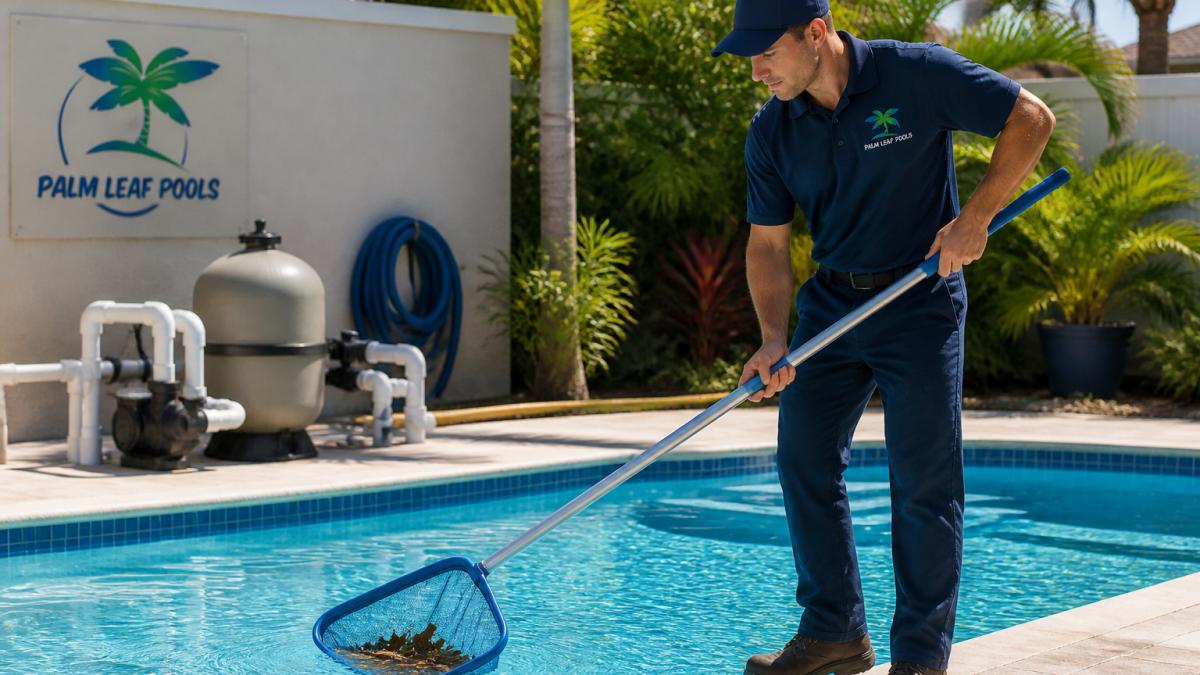
Here's what a standard weekly service visit should include:
Debris Removal and Surface Cleaning
Your technician should skim the surface to remove leaves, branches, and floating debris, preventing organic matter from sinking and decomposing, which degrades water quality and strains filtration.
Brushing the walls and floor removes algae buildup before it becomes visible, early growth happens on surfaces you can't see from poolside, and a professional catches it at this stage.
Vacuuming removes settled debris and dead algae, especially important in vinyl-liner pools where debris can damage the surface if left too long.
Filter and Circulation System Inspection
Your filter is the heart of pool maintenance. A qualified technician inspects the pressure gauge each visit; rising pressure means the filter needs cleaning.
Your technician should verify the pump runs smoothly, check for leaks around the pump housing, and listen for unusual sounds signaling motor wear.
A simple circulation check catches problems early. When water isn't circulating properly, dead zones form where algae thrives and chemical balance fails.
Pool Chemical Testing and Balancing
Water chemistry affects everything: swimmer safety, equipment lifespan, and water clarity. That's why pool chemical testing and balancing ranks as a critical pool cleaning service feature.
A professional tests at least four key parameters during each visit: chlorine level, pH, alkalinity, and calcium hardness.
Chlorine sanitizes the water and kills bacteria. It should stay between 1-3 ppm for residential pools.
pH measures acidity. When pH drifts outside this range, chlorine becomes less effective and equipment corrodes faster (the CDC).
Alkalinity acts as a pH buffer, preventing wild swings. Low alkalinity means pH becomes unstable and hard to control.
Calcium hardness prevents corrosion and scaling.
A technician who explains these numbers as they adjust them is giving you real value.
Equipment Inspection and Preventive Maintenance
Equipment inspection separates a maintenance service from a true pool care partner. Your pump, motor, filter, heater, and circulation lines represent thousands of dollars; preventive maintenance catches wear before failure.
During each visit, a technician should visually inspect:
- Pump housing for leaks or corrosion
- Motor bearings for unusual noise or vibration
- Filter tank for cracks or loose fittings
- Heater connections for leaks or loose clamps
- Circulation lines for visible cracks or loose connections
- Skimmer basket and pump strainer for debris that restricts flow
Small issues caught early can prevent more expensive repairs or full equipment replacement down the line.
A provider who documents inspections with photos or notes holds themselves accountable, you'll know exactly what was checked and its condition.
Questions to Ask a Pool Service Company Before Hiring
Before committing to a pool maintenance contract, ask direct questions.
What's included in a standard weekly visit? A vague answer ("We clean your pool") is a red flag.
What happens if you find a problem? Do they contact you immediately or wait until it's critical?
Are you insured and licensed? Ask for proof of liability insurance and any required state certifications.
What's your communication policy? How quickly do they respond to calls or texts? Do they provide seasonal recommendations?
Understanding Pool Cleaning Service Cost and Contract Terms
Most guides say pool service 'varies by market', true but useless when three quotes differ by $80 a month. The real skill is knowing which line items drive the number and which contract clauses change what you pay over twelve months.
The line items that actually move the price
Base service fee. Covers labor and the routine visit, skimming, brushing, vacuuming, filter check, and a basic chemical test.
Chemical allowance. The biggest source of quote confusion.
Equipment and repair labor. Maintenance-only providers exclude repairs; others include minor adjustments (a skimmer basket, a valve O-ring) but bill anything requiring parts.
Add-on services. Seasonal opening and closing, acid washing, filter media replacement, green-pool recovery, and tile cleaning are almost always priced separately.
Contract terms that change your real cost
- Term length and auto-renewal. Month-to-month costs more per visit but lets you leave. Annual agreements discount the rate but often auto-renew unless you give written notice, sometimes 30 or 60 days out. Put the notice window on your calendar the day you sign.
- Cancellation and early-termination terms. Ask what happens if you sell, drain the pool, or move. Some contracts allow transfer to the new owner; others charge a termination fee of one or two months.
- Skipped-visit policy. If the provider misses a visit, is it credited, made up, or forfeited? If you're traveling, can you pause service without penalty?
- Price-increase clause. Many annual contracts include a mid-term increase tied to chemical costs. Ask whether the rate is locked for the full term or adjustable.
- Payment terms. Autopay discounts are common; late fees and returned-payment fees are less discussed. Read the fine print.
How to compare quotes without a universal price
There's no single 'correct' price, pool size, debris load, screen enclosure, tree cover, and local labor rates all move the number. Normalize the quotes:
- Convert every quote to a monthly cost for the same visit frequency.
- Add the estimated chemical spend based on your pool's history (ask a prior provider or a pool store for your average monthly chemical cost).
- Add add-on services you know you'll need, opening, closing, filter cleaning.
- Note any variable charges (fuel surcharge, overage chemicals) and ask for a realistic monthly range, not a floor.
The lowest base fee is frequently the most expensive once chemicals and add-ons are layered in; the highest base fee sometimes includes chemicals and minor repairs, making it cheaper in practice.
Reliability, Communication, and Accountability
Technical skill gets a provider in the door. What keeps them there is whether you can verify what they did, reach them when something goes wrong, and hold them responsible. Those three things are measurable, ask for the measurements before you hire.
Reliability you can actually verify
'We always show up' is a claim; a visit log is evidence. Ask a prospective provider for a sample of the record they leave after each visit. A useful record includes:
- Date and time in / time out for the visit
- Technician name (so you know who was on your property)
- Chemical readings before and after adjustment, free chlorine, pH, total alkalinity, calcium hardness, and stabilizer (cyanuric acid) at minimum
- Chemicals added with quantities
- Tasks completed, skimmed, brushed, vacuumed, filter checked, baskets emptied
- Equipment observations, anything that looked worn, leaking, or noisy
- Photos of the equipment pad and any issue flagged
If a provider can't produce a sample visit report, they aren't tracking their own work, which means you can't either. That's the first filter.
Communication standards worth writing into the agreement
Ask each provider to commit to specific response windows, not general promises:
- Routine question response time, for example, same business day for non-urgent questions
- Problem notification, how quickly they contact you after finding an equipment issue (same visit vs. end of day vs. end of week)
- Approval threshold, the dollar amount above which they must get your approval before performing a repair. A common pattern is anything beyond routine maintenance requires a written estimate first.
- Escalation path, who you call if the technician doesn't resolve your issue, and how quickly that person responds
- Seasonal communication, do they send a heads-up before opening and closing season, or do you have to chase them?
A provider who resists putting response windows in writing is telling you how they handle problems.
Accountability mechanisms to look for
Accountability isn't a personality trait, it's a set of practices. Providers who stand behind their work share these:
- Written service agreement that spells out scope, exclusions, and what happens if a visit is missed
- Liability insurance, ask for a certificate and confirm effective dates. If a technician damages a pump, heater, or your deck, the provider's policy should respond, not your homeowner's policy.
- Licensing and certification where required, requirements vary by state and locality; ask what applies in your area and for proof.
- References from current customers, not just names, but customers you can call who've been with the provider at least a year. Ask: Has the provider ever missed a visit? How did they handle it? Have you had a dispute, and how was it resolved?
- A defined remedy for missed or substandard visits, credit, make-up visit, or refund. Get it in writing.
A simple scoring approach
When comparing two or three providers, score each on the same five criteria:
- Visit documentation, sample report available? Yes / No
- Response commitments, written response windows? Yes / No
- Insurance and credentials, certificate provided? Applicable certifications held?
- Reference quality, at least two references reachable, one year or longer tenure?
- Remedy policy, written policy for missed or substandard visits?
A provider who scores well on all five is almost always the one you want, even if their base fee isn't the lowest. One who scores poorly on documentation and insurance is a liability regardless of price.
Frequently Asked Questions
What should weekly pool service include?
A comprehensive weekly pool cleaning service should include debris removal (skimming and vacuuming), brushing pool walls and floor, filter cleaning or backwashing, water testing and chemical balancing, pump and motor inspection, and equipment checks. The technician should verify sanitizer levels, pH balance, and alkalinity. Some services also include equipment repairs or adjustments to prevent future problems. Ask your provider for a detailed checklist of what their weekly visit covers.
How often should a pool be professionally cleaned?
Most residential pools benefit from weekly professional cleaning and maintenance. However, frequency depends on pool size, usage, climate, and whether the pool is saltwater or chlorine-based. Pools with heavy use or in areas with significant debris may need twice-weekly service. Seasonal variations matter too: during summer, weekly visits are standard; in winter, frequency may decrease. Discuss your specific situation with a qualified pool service provider to determine the right schedule for your pool.
What questions should I ask before hiring a pool maintenance company?
Ask about their service visit checklist, response time for repairs, whether they provide written reports after each visit, and how they handle emergency situations. Inquire about their experience with your specific pool type (vinyl, saltwater, etc.), insurance coverage, and technician credentials. Request references and clarify pricing structure, contract terms, and what happens if major issues are discovered. Also ask how they communicate updates and whether they offer seasonal maintenance adjustments.
Does pool cleaning service cost include chemical testing and balancing?
Most professional pool cleaning services include basic chemical testing and balancing as part of their standard weekly visit. However, coverage varies by provider and service tier. Some may charge separately for advanced water analysis or chemical treatments beyond routine balancing. Before signing a contract, confirm that chemical testing, pH adjustment, and sanitizer level maintenance are included in your quoted price. Request clarity on what additional treatments might cost if discovered during service visits.