 blog
Pool Maintenance Service Alternatives: 2026 Guide
Last Updated: October 22, 2026
Quick Summary
Pool maintenance service alternatives range from full professional weekly service to DIY approaches and robotic cleaners combined with periodic inspections. The best choice depends on your available time, technical comfort with chemistry, and budget, with hybrid approaches offering a middle path for many homeowners.
- The average homeowner spends 5-10 hours monthly on pool upkeep without professional help.
- DIY pool maintenance costs $550-1,450 annually in chemicals and supplies but requires 6-9 hours monthly and risks costly algae blooms if schedules slip.
- Robotic pool cleaners cost $500-3,000 and reduce maintenance time to 3-4 hours monthly when paired with professional inspections.
- Weekly professional service typically costs around $35 per visit when billed monthly, with extra charges for algae recovery and chemical overages.
- A hybrid approach combining a robotic cleaner with quarterly professional inspections often provides the best value for time-constrained homeowners.
Table of Contents
- Why Pool Maintenance Service Alternatives Matter
- Professional Weekly Pool Service: What to Expect
- DIY Pool Maintenance: Tasks, Timeline, and Realistic Costs
- Pool Cleaning Robot Options and Hybrid Approaches
- Understanding Pool Maintenance Cost Across Options
- How to Choose the Right Pool Maintenance Service Alternative
- Frequently Asked Questions
Why Pool Maintenance Service Alternatives Matter
Pool ownership brings freedom and joy, until maintenance demands consume your weekends. The average homeowner spends 5-10 hours monthly on pool upkeep, testing chemicals, scrubbing walls, and troubleshooting equipment failures. For many, that's time they don't have. Pool maintenance service alternatives exist on a spectrum: from full professional management to DIY approaches to automated solutions. The right choice depends on your budget, available time, and comfort level with technical tasks.
The U.S. swimming pool cleaning services market was valued at $8.8 billion in 2026, according to IBISWorld's industry analysis, reflecting how many homeowners outsource this responsibility. Yet not everyone needs a full weekly service contract. Some pools thrive with hybrid approaches combining robotic cleaners and monthly professional inspections. Others demand hands-on weekly attention. Understanding your options prevents costly mistakes and keeps your investment safe.
Professional Weekly Pool Service: What to Expect
Professional weekly pool service remains the most reliable option for busy homeowners. A technician visits your property on a set schedule, typically spending 1-2 hours testing water chemistry, skimming debris, brushing walls, vacuuming the floor, and inspecting equipment.
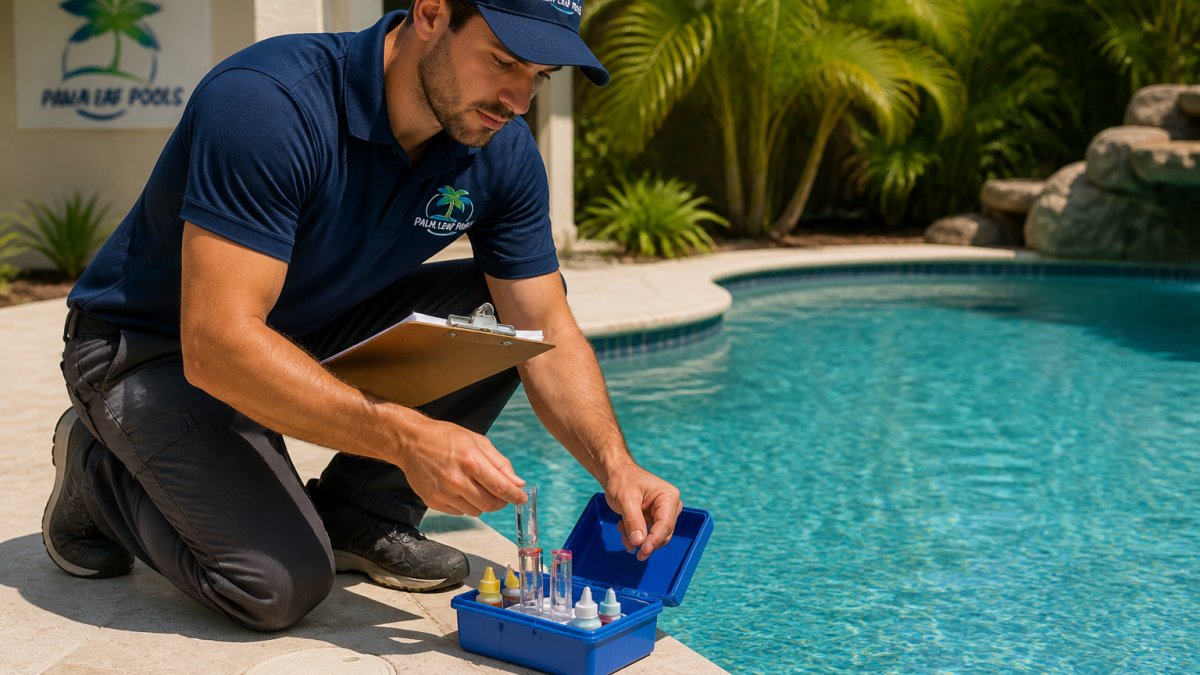
What separates quality service from mediocre is consistency and communication. Our team provides regular photo documentation of your pool's condition and alerts you immediately if repairs become necessary, before small problems turn into expensive emergencies.
Weekly service typically includes:
- Water chemistry testing and adjustment
- Skimming and debris removal
- Brush and wall cleaning
- Equipment inspection
- Filter maintenance
- Monthly or seasonal equipment servicing
The cost varies based on pool size, condition, and your location, so we recommend requesting a quote tailored to your specific situation. Most homeowners report that the peace of mind and time savings justify the investment.
DIY Pool Maintenance: Tasks, Timeline, and Realistic Costs
DIY pool maintenance is a real alternative, not a compromise, but only for homeowners who will actually keep the schedule. The task list is straightforward; the cost and the failure modes are where most guides stay vague.
Core DIY tasks break down like this:
| Task | Frequency | Time Required | Difficulty |
|---|---|---|---|
| Skimming debris | 2-3 times weekly | 10 minutes | Easy |
| Water testing | 2-3 times weekly | 15 minutes | Easy |
| Chemical adjustment | 1-2 times weekly | 20 minutes | Moderate |
| Brushing walls | Weekly | 30 minutes | Easy |
| Vacuuming floor | Weekly | 45 minutes | Moderate |
| Filter cleaning | Monthly | 30 minutes | Moderate |
| Equipment inspection | Monthly | 15 minutes | Moderate |
That schedule adds up to roughly 6-9 hours per month for a typical residential pool, more during heavy-use or storm weeks.
Now the realistic annual cost, built from the line items rather than a single range:
| Cost line | Typical annual amount | Notes |
|---|---|---|
| Test kit or strips | $50-150 | Liquid test kits cost more upfront and last longer than strips |
| Chemicals (chlorine, acid, stabilizer, shock) | $300-700 | Rises with pool size, heat, and bather load |
| Basic equipment (brush, net, vacuum head, hose) | $100-250 | One-time, replaced every few years |
| Filter media replacement | $50-200 | Sand or cartridge replacement on a multi-year cycle |
| Opening and closing supplies | $50-150 | Plugs, covers, winterizing chemicals where applicable |
| Estimated annual total | $550-1,450 | Before any repair or recovery costs |
The number that rarely appears in DIY guides is the recovery cost.
There is also the opportunity-cost calculation. At an assumed value of $25-50 per hour for your time, 6-9 hours monthly represents $150-450 per month in labor you are supplying yourself.
DIY fits you if all of these are true:
- You can commit to testing water 2-3 times per week without skipping.
- You are comfortable reading test results and adjusting chemicals to a target range.
- You have 6-9 hours per month available during pool season.
- You are willing to learn basic equipment maintenance and recognize when to call a professional.
- Your budget priority is minimizing out-of-pocket spending rather than minimizing time.
DIY is a poor fit if you travel frequently, if your pool sees heavy bather load, or if you are uncomfortable with chemistry.
A practical middle path is to run DIY for routine tasks and book a professional inspection at the start of the season and again mid-season. That gives you a documented baseline for chemistry and equipment without paying for weekly visits, and it catches the problems DIY owners most often miss.
Pool Cleaning Robot Options and Hybrid Approaches
Robotic pool cleaners automate the physical labor of floor and wall cleaning. Modern units operate independently, using brushes and suction to remove debris while you focus on chemistry and equipment maintenance.
These robots excel at their core task: they clean surfaces consistently without human effort. However, they don't test water chemistry, adjust chemical levels, or inspect equipment, tasks that remain your responsibility.
The hybrid approach combines a robotic cleaner with quarterly or bi-monthly professional inspections. This strategy delivers several advantages:
- Automated daily cleaning maintains pool appearance
- Professional inspections catch equipment problems early
- You avoid the full weekly service cost
- Chemical management remains your responsibility
For homeowners comfortable with basic chemistry but lacking time for physical cleaning, this hybrid model often provides the best value. It costs less than full weekly service while eliminating the heavy lifting.
Research from Service Business Academy's 2026 software comparison notes that pool-service software platforms now include robotic cleaner integration, allowing technicians to monitor performance and recommend maintenance proactively. This emerging capability strengthens the hybrid approach's effectiveness.
Understanding Pool Maintenance Cost Across Options
Most pricing guides give you a single annual range and leave you to guess why two neighbors with similar pools pay very different amounts. The honest way to compare pool maintenance alternatives is to normalize the numbers: cost per visit, cost per month, what is included, and what triggers extra charges. That is the comparison most local directories and provider pages never publish.
Start with the unit that actually matters: cost per service visit. A weekly professional plan is priced per visit, not per month, even when it is billed monthly. If a plan quotes $150 per month for weekly service, that is roughly $35 per visit across four visits.
Here is how the main alternatives normalize on the same basis:
| Approach | Typical billing unit | What the price usually includes | What triggers extra charges |
|---|---|---|---|
| Weekly professional service | Per visit, billed monthly | Chemistry testing and adjustment, skimming, brushing, vacuuming, filter check, equipment visual inspection | Green-to-clean recovery, filter deep clean, parts, holiday visits, chemical overages |
| Biweekly or monthly professional service | Per visit | Same task list at lower frequency | Algae recovery, storm cleanup, extra visits between scheduled ones |
| Hybrid (robotic cleaner plus periodic pro inspection) | Equipment purchase plus per-inspection fee | Surface cleaning by robot; chemistry and equipment checked at inspection | Replacement brushes, filters, robot parts, emergency calls |
| Full DIY | Per task and per chemical purchase | Nothing bundled; you supply labor, test kit, chemicals, and equipment | Equipment repair, drain and refill, shock treatments after a miss |
Chemical charges are the most common source of bill surprise. Some providers include a standard chemical allowance in the monthly rate and bill overages separately; others charge chemicals at cost plus a markup on every visit. Ask which model applies and what the allowance covers.
Contract terms change the real price too. Compare these line items across quotes:
- Minimum commitment: month-to-month versus a seasonal or annual term.
- Cancellation notice: 30 days is common; some require 60 or charge a buyout.
- Missed-visit policy: whether a rained-out or skipped visit is credited, rescheduled, or lost.
- Price escalation: whether the rate is locked for the season or adjusted mid-term.
- Technician consistency: whether you get the same technician each visit, which affects how quickly problems are caught.
- Service guarantee: what happens if water clarity or chemistry is off between visits.
A simple way to compare two quotes is to build a 12-month cost estimate for each: monthly rate times 12, plus estimated chemical overages, plus any seasonal opening and closing fees, plus the expected cost of one mid-season recovery visit. That total, divided by 12, is the number to compare, not the advertised monthly rate.
How to Choose the Right Pool Maintenance Service Alternative
Your decision hinges on three variables: available time, technical comfort, and budget flexibility. Start by honestly assessing each.
Time available: If you have fewer than 3 hours monthly available for pool maintenance, professional service or a hybrid approach makes sense. If you genuinely enjoy the work and have 8+ hours monthly, DIY becomes viable.
Technical comfort: Pool chemistry isn't rocket science, but it does require consistency and basic math. If you're comfortable reading test results and adjusting chemicals based on guidelines, DIY is feasible.
Budget flexibility: Professional weekly service costs more upfront but provides insurance against equipment failures and ensures consistent water quality. DIY costs less monthly but demands your time and carries risk if you miss maintenance windows.
Consider starting with a hybrid approach: hire a professional for quarterly inspections while you handle basic maintenance. This strategy lets you test your comfort level without committing to full DIY or expensive weekly service.
The right pool maintenance service alternative depends on what you value most: time, money, or peace of mind. Our team protects your investment and makes pool ownership effortless, allowing you to focus on enjoying your backyard rather than maintaining it. Contact Palm Leaf Pools today for a consultation and discover how we can simplify your pool care.
Frequently Asked Questions
What should a weekly pool service checklist include?
A comprehensive weekly pool service checklist covers skimming debris from the surface, vacuuming the pool floor, brushing walls and tile, emptying skimmer baskets, testing and balancing water chemistry, inspecting equipment for leaks or damage, and cleaning or backwashing the filter. Professional technicians document each task and provide photo evidence. This routine prevents algae growth, maintains water quality, and catches equipment problems early before they become expensive repairs.
How much does professional pool maintenance cost compared to DIY?
Annual pool-service spending ranges from a few hundred dollars for basic upkeep to more than $8,000 for larger pools or hands-off care. DIY maintenance requires purchasing chemicals, test kits, and equipment, often $500-$1,500 yearly, plus your time investment. Professional service eliminates the learning curve and time commitment but costs more upfront. Many homeowners find the reliability and peace of mind worth the expense, especially for pools requiring consistent attention.
Can a pool cleaning robot replace professional pool service?
Robotic pool cleaners handle vacuuming and debris removal effectively, but they cannot replace professional service entirely. Robots do not test water chemistry, balance chemicals, inspect equipment, or clean filters. A combined approach works best: use a robot for daily debris removal while hiring professional service monthly or quarterly for chemical testing, equipment inspection, and deep maintenance. This hybrid method reduces the frequency of professional visits while maintaining water safety and equipment health.
How often should a professional service a pool?
Most pools benefit from weekly professional service to maintain water quality, prevent equipment issues, and ensure consistent cleanliness. Some homeowners with robotic cleaners or strong DIY skills opt for bi-weekly or monthly visits. Frequency depends on pool size, usage, climate, and your comfort level managing maintenance. Discuss your pool's specific needs with a service provider to establish the right schedule for your situation and budget.