 how-to
How Long Does Pool Resurfacing Take? A Step-by-Step Timeline
Last Updated: November 7, 2026
Quick Summary
Active crew work on most pool resurfacing jobs takes about 5 to 14 days, but total time to swim-ready is longer because curing, refilling, and chemical balancing add more days. Curing alone typically runs 3 to 7 days, and refilling takes 12 to 48 hours depending on pool volume.
- Active crew work on most residential jobs takes 5 to 14 days, according to Swimply's 2026 guide.
- Curing typically takes 3 to 7 days, and the surface must stay damp and protected during that time.
- Refilling takes 12 to 48 hours depending on pool volume and water pressure.
- Water chemistry can take several more days to stabilize after the pool is filled.
- Ask your contractor for completion, refill, and swim-ready dates in writing before work begins.
Table of Contents
- How Long Pool Resurfacing Takes From Start to Swim-Ready
- Step-by-Step Pool Resurfacing Process and Timeline
- Factors That Change the Duration of Your Project
- How Long a Resurfaced Pool Needs to Cure Before Refilling and Swimming
- Pool Resurfacing Versus Replastering: How the Timelines Compare
- What a Pool Resurfacing Looks Like Before and After Completion
- Booking Your Resurfacing With Palm Leaf Pools
- Frequently Asked Questions
Palm Leaf Pools gets asked one question more than any other: how long does pool resurfacing take? The honest answer is that active work on most jobs takes a number of days, and that is only part of the story. The rest is curing time, refilling, and balancing the water before anyone can swim. Swimply's 2026 guide puts the active work range at 5 to 14 days, with curing time added on top, and Angi's 2026 cost guide estimates five to seven days for a typical job, noting that pool size and materials change the schedule. Swimply 2026 pool resurfacing cost guide
This guide walks through the full timeline from the first day of demolition to the first swim, so you can plan around it.
How Long Pool Resurfacing Takes From Start to Swim-Ready
The total time from start to swim-ready depends on the finish, the weather, and the pool's size. Curing, refilling, and chemical balancing make up a large share of that time.
The biggest mistake homeowners make is counting only the crew days. A pool can be finished on paper and still be unusable for another week or more. D&J The Pool Resurfacers guide on refill and water balancing estimates refilling takes 12 to 48 hours depending on pool volume and water pressure, and water chemistry can take several more days to stabilize after filling.
Step-by-Step Pool Resurfacing Process and Timeline
Every resurfacing job follows the same basic sequence, but the calendar time depends on which steps are active crew work and which are waiting. The table below separates the two so you can see where the days actually go.
| Step | What Happens | Crew Time vs. Waiting Time |
|---|---|---|
| 1. Drain the pool | Water is pumped out and the shell is inspected for cracks, delamination, and loose tile | Active, usually 1 day |
| 2. Remove the old finish | Old plaster, pebble, or aggregate is chipped or ground away | Active, 1-2 days depending on surface area and finish hardness |
| 3. Repair the shell | Cracks are filled and damaged areas are patched | Active, 0-2 days depending on what is found |
| 4. Apply the bond coat | A thin layer helps the new finish adhere to the shell | Active, same day as finish application |
| 5. Install the new finish | Plaster, quartz, or aggregate is troweled on, often one continuous session per section | Active, 1 day for most residential pools |
| 6. Cure the finish | The surface hardens slowly and must stay damp and protected | Waiting, typically 3-7 days depending on material |
| 7. Refill and balance | Water goes back in, then pH, alkalinity, and calcium hardness are adjusted | Waiting, 1-3 days |
Day-by-Day Schedule: Active Work Versus Waiting
Here is what a typical plaster job on an average residential pool looks like when you map it to calendar days. Your dates will shift with pool size, finish, and weather, but the pattern holds.
- Day 1: Drain the pool and inspect the shell. Crew on site.
- Day 2: Remove the old finish. Crew on site.
- Day 3: Make repairs and apply the bond coat. Crew on site.
- Day 4: Apply the new finish. This is the most intense day, and the crew may stay late to keep the material workable.
- Days 5-9: Curing. No crew on site. The surface must be kept damp, often by misting or covering, and it must be protected from rain, debris, and foot traffic.
- Day 10: Begin refilling. A typical residential pool takes 12-48 hours to fill depending on volume and water pressure.
- Days 11-14: Balance the water and run the filtration system. Chemistry is tested daily until pH, alkalinity, and calcium hardness hold steady.
When discussing schedules with any contractor, ask them to walk you through the cure and startup schedule for your specific material in writing.
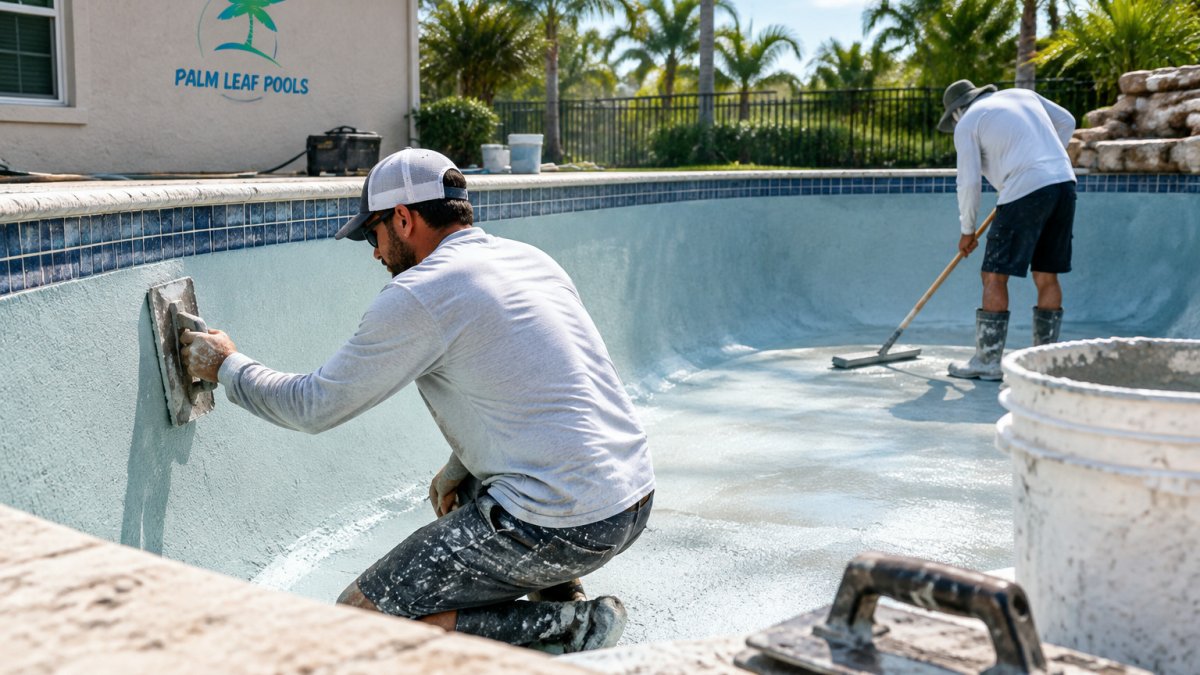
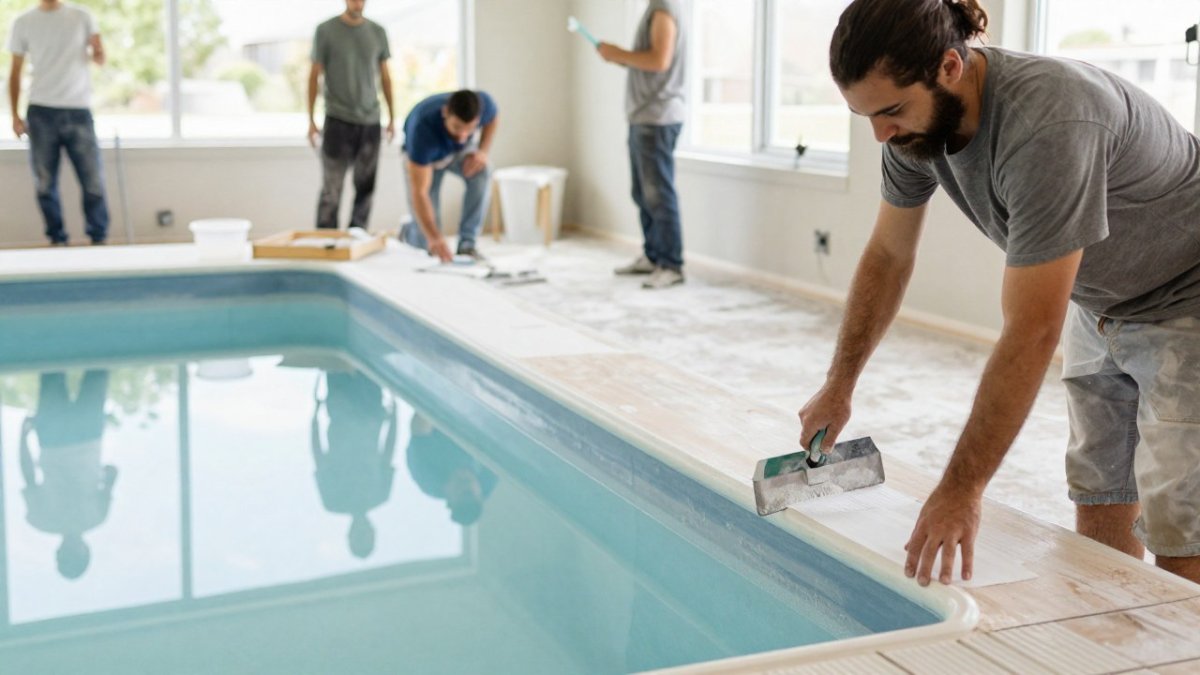
!A crew of workers in work clothes applying a fresh plaster finish with trowels inside an empty residential pool under daylight
Factors That Change the Duration of Your Project
Several things stretch or shorten a resurfacing schedule. Knowing them helps you set realistic expectations.
- Pool size and volume. Larger pools need more finish, more time to fill, and more time for chemistry to stabilize.
- Finish type. Quartz and aggregate finishes often need different curing windows than standard plaster. Ask your contractor for the exact schedule for your material.
- Weather. Rain, high humidity, and extreme heat all affect curing. Cold weather slows the cure, and heavy rain can force a delay.
- Hidden damage. Cracks or structural problems found after draining can add days to repairs.
- Permits and access. Some municipalities require permits before work starts. Tight access to the backyard can slow equipment delivery.
- Contractor scheduling. Crews often juggle multiple jobs. A booked calendar can push your start date back.
Your project's finish choice matters too. A plaster job and a quartz job of the same size may carry different timelines, so compare the schedules before you sign a contract. For a deeper look at how finish choice affects both cost and scheduling, see our Pool Resurfacing Cost Analysis: Finishes, Estimates & Hidden Fees.
How Long a Resurfaced Pool Needs to Cure Before Refilling and Swimming
Curing is the most misunderstood part of the process, and it is where finish choice matters most. The new surface needs time to harden before water touches it, and different materials need different windows. The table below compares common finishes by cure time, refill timing, and startup requirements. Treat these as typical ranges to discuss with your contractor, not universal rules, because product-specific instructions always govern.
| Finish | Typical Cure Before Refill | Refill and Startup Notes |
|---|---|---|
| Standard plaster (white or colored) | 3-7 days, kept damp | Fill slowly, then balance pH and alkalinity before running the filter continuously |
| Quartz aggregate | 3-5 days, kept damp | Similar to plaster; some products call for a longer no-swim window |
| Pebble and exposed aggregate | 5-7 days, kept damp | Often requires a longer initial fill and a slower chemistry ramp |
| Fiberglass or acrylic | Manufacturer-specific, often 24-72 hours | Follow the product data sheet; startup chemistry differs from cement-based finishes |
Completion, Refill, and Swim-Ready Are Three Different Dates
Homeowners often hear "the pool is done" and assume they can swim. In practice there are three milestones, and they can be a week or more apart.
- Completion: The crew has finished applying the finish and left the site. The pool is empty and the surface is curing.
- Refill: Water goes back in, usually 12-48 hours depending on pool volume and water pressure. The pool looks full but is not necessarily safe.
- Swim-ready: The finish has cured per the manufacturer's instructions, the water chemistry has stabilized, and the filtration system has run long enough to clear the water. This is the date to plan around.
Ask your contractor for all three dates in writing before work begins, and ask which one their warranty clock starts on.
Once the pool is refilled, balance pH, alkalinity, and calcium hardness, then run the filtration system to circulate the water. Test daily until the readings hold steady. Only after the chemistry reads safe and the cure window has passed should you swim.
Watch out: if your contractor hands you a single "done" date without separating completion, refill, and swim-ready, ask them to break it out. The gap between those dates is where most scheduling surprises come from.
Pool Resurfacing Versus Replastering: How the Timelines Compare
Resurfacing and replastering are often used interchangeably, but they differ in scope. Resurfacing usually means removing the old finish and applying a new one over the shell. Replastering is typically the same process applied to plaster surfaces. In both cases the timeline is driven by the same steps: draining, removing, repairing, applying, curing, and refilling.
The practical difference is usually cost and material rather than time. Expect a similar overall schedule, with the finish type adding or subtracting a few days.
What a Pool Resurfacing Looks Like Before and After Completion
Before resurfacing, many pools show stains, rough patches, or flaking plaster. After the job, the surface is smooth, uniform in color, and free of the cracks or loose areas that marked the old finish.
Watch for progress during the job. The drained shell should show clean repairs, and the new finish should cure evenly without patches or discoloration.
Booking Your Resurfacing With Palm Leaf Pools
Planning your timeline is the first step. The next is finding a contractor who communicates clearly and keeps to the schedule they promise. If you are ready to start, book a pool remodel consultation to get a timeline based on your pool's size, finish, and site conditions. You can also review how to choose a pool renovation company before you commit.
Call Today!
BUTTON: Schedule Your Consultation CARD_TITLE: Ready to plan your resurfacing? CARD_TEXT: Palm Leaf Pools builds clear schedules for pool resurfacing and remodeling across Dallas-Fort Worth.
Frequently Asked Questions
How many days does it take to resurface a pool?
Pool size, the finish material, and weather all affect how long resurfacing takes. Curing time and the refill and water-balancing period come on top of the active work, so the pool is usually not ready to swim in right away. Ask your contractor for a day-by-day schedule that separates active work from waiting time.
How long after pool resurfacing can you swim?
Most pools cannot be swum in until the finish has cured and the water is refilled and balanced. Refilling time depends on pool volume and water pressure. Water chemistry then needs several days of adjustment, including pH, alkalinity, and calcium hardness, before the pool is safe. Your contractor should give you a specific swim-ready date based on your finish and the chemical startup plan.
Does the type of pool finish affect resurfacing time?
Yes. Plaster, quartz, pebble, and aggregate finishes differ in application method, troweling time, and curing requirements, so their timelines are not identical. Ask your contractor how long the specific finish you choose needs to cure before refilling and before swimming.
What can delay a pool resurfacing project?
Common delays include rain and temperature swings during application, hidden damage such as cracks or delaminated plaster found after the old finish is removed, and contractor scheduling conflicts. Access problems and permit requirements can also add days. Planning around weather and confirming the scope of surface repairs before starting helps keep the timeline on track.