 Listicle
9 Alternatives to Traditional Pool Covers Worth Considering
Last Updated: November 9, 2026
Quick Summary
The most useful alternatives to pool covers include mesh and solid safety covers, automatic covers, solar blankets, solar rings, and liquid solar covers. Mesh covers drain water and suit open, windy yards, solid covers suit wooded yards, and automatic covers suit irregular pools but need track planning.
- Mesh safety covers drain rain and debris, suiting open, windy yards with less weight to handle.
- Solid safety covers block sunlight and debris but hold standing water that must be pumped off.
- Automatic covers suit freeform and irregular pools but require track planning during construction or remodeling.
- Solar blankets are cheapest for holding heat, but they are not safety barriers and degrade under UV.
Table of Contents
- Mesh vs. Solid Pool Covers: Which Fits Your Pool
- Automatic Pool Covers for Irregular Shapes
- Solar Blankets, Sun Rings, and Liquid Solar Covers
- Best Pool Cover Options for Inground Pools
- How to Cover a Pool Permanently Without a Traditional Cover
- Booking a Pool Assessment With Palm Leaf Pools
- Frequently Asked Questions
Homeowners often ask whether there are practical alternatives to pool covers that avoid the traditional cover that comes out every night? Traditional covers work, but they are heavy, slow to use, and often a chore. Several alternatives exist, each with its own tradeoffs in safety, cost, and upkeep. This guide walks through the most useful options so you can decide what fits your pool, your yard, and your routine.
Most homeowners look beyond traditional covers for a few practical reasons. Some want a cover that deploys without manual lifting. Others want to cut water loss or heat loss, or they simply need a safer barrier for children and pets. A solid answer depends on pool shape, whether the pool is inground or above-ground, and how much maintenance you are willing to take on.
Mesh vs. Solid Pool Covers: Which Fits Your Pool
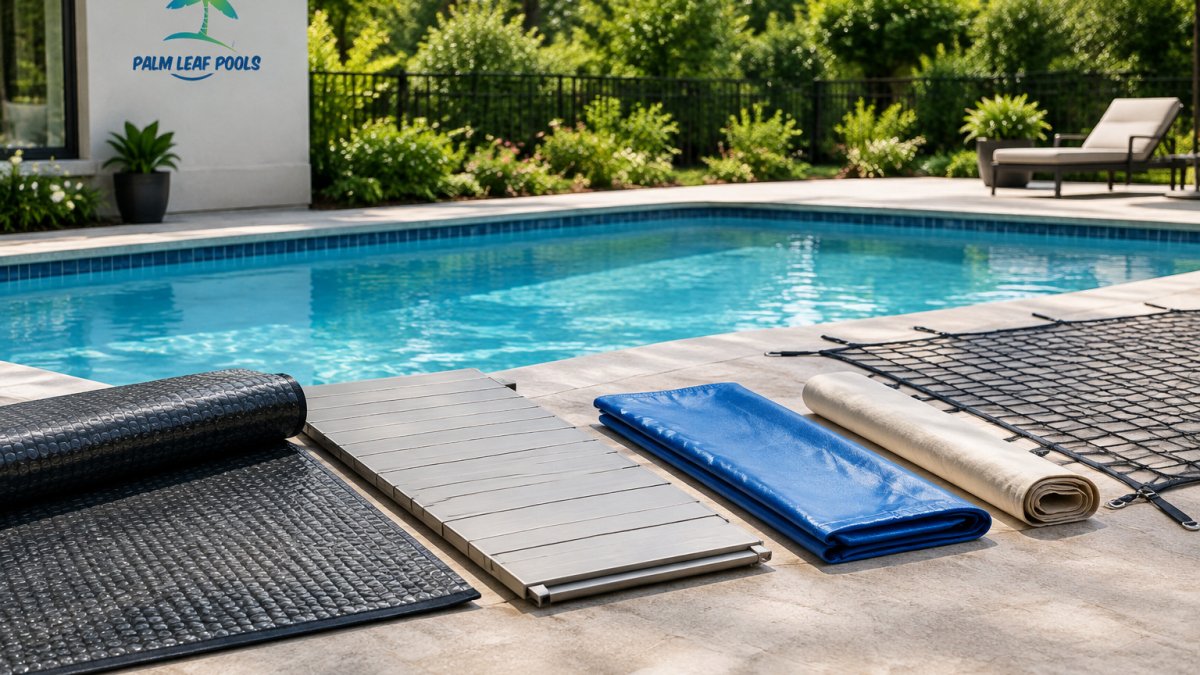
Mesh and solid safety covers are the two main categories most homeowners compare first. A mesh safety cover lets rain and debris drain through its weave, which keeps standing water off the surface. A solid cover blocks sunlight and debris entirely, but water and leaves sit on top and must be pumped or removed.
In practice, solid covers suit heavily wooded yards where leaves are the main problem. Mesh covers suit open, windy sites where you want drainage and less weight on the cover.
Automatic Pool Covers for Irregular Shapes
Automatic covers roll or retract on a track system, which makes them the most convenient of the alternatives to pool covers for daily use. They are often recommended for freeform pools and irregular shapes, where a fitted manual cover can be hard to size and anchor. The trade-off is cost and installation complexity: the track must be built into the deck or coping, so retrofitting an older pool can be expensive.
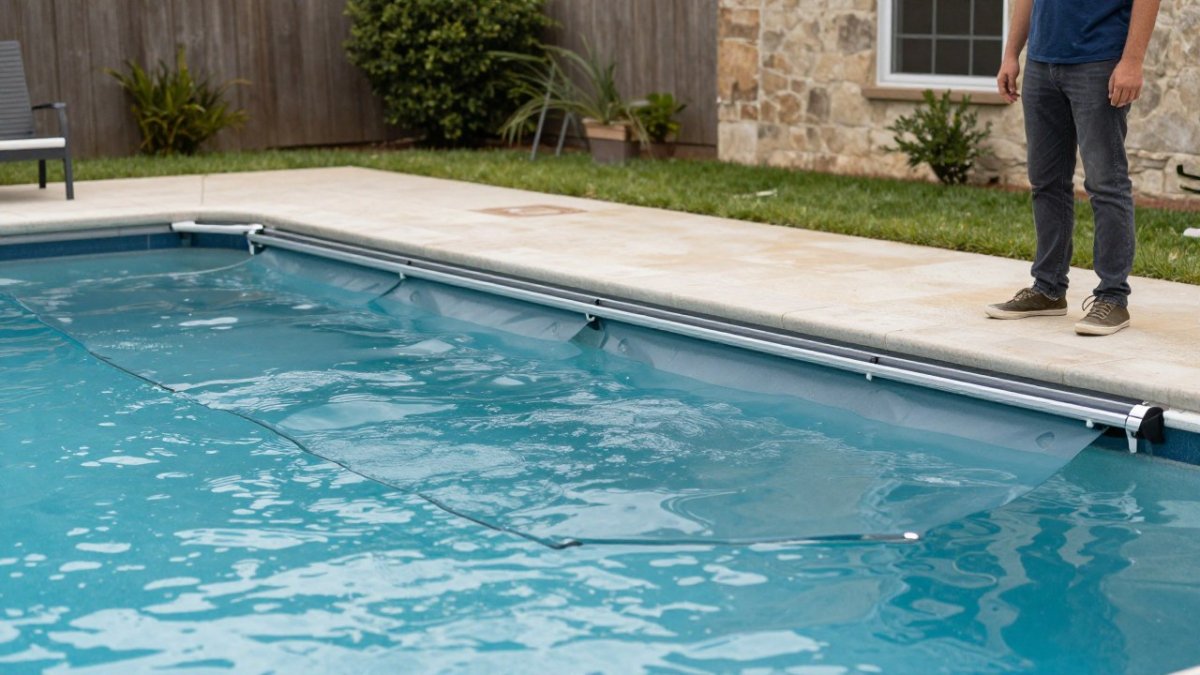
Before committing, confirm the track layout works around steps, benches, and waterfalls. A common mistake is choosing an automatic system without checking how it handles the pool's corners.
Solar Blankets, Sun Rings, and Liquid Solar Covers
These three options share one job: slowing heat loss and evaporation without a physical safety barrier. They are the cheapest alternatives to a traditional cover, but they behave very differently in practice, and none of them satisfies ASTM F1346 or any other safety-cover standard.
Bubble solar blankets. A bubble blanket is a sheet of UV-stabilized polyethylene with sealed air cells, usually 8 to 12 mil thick, cut to the pool's shape and floated bubble-side down. The trapped air insulates the surface and reduces both evaporative and convective heat loss. A blanket can help a heated pool hold temperature with shorter heater run times. The trade-offs are real: the blanket must be removed before swimming, it collects debris on top, and it degrades under UV. Lifespan varies with sun exposure and how carefully the blanket is handled.
Solar rings. These are inflatable or foam rings, typically 4 to 6 feet across, that float on the surface and link together with clips or overlap to cover most of the water. They are easier to remove than a full blanket and pack down small, which suits irregular pools and owners who swim often. Coverage is the catch: gaps between rings let heat and vapor escape, so the effective reduction in evaporation is smaller than a full blanket delivers. Rings also blow around in wind and need to be gathered and stored. They are a reasonable compromise for a pool that is used daily, not a substitute for a blanket on a pool that sits closed for weeks.
Liquid solar covers. A liquid cover is a surfactant or alcohol-based product poured onto the water; it spreads into a monomolecular film that lowers surface tension and slows evaporation. Liquid covers can reduce evaporation for water conservation, but they are generally less effective than a physical blanket, and the film breaks down in wind, rain, and heavy bather load, so it must be reapplied on a schedule. Liquid covers leave no residue that requires removal, which is their main advantage, and they do not interfere with swimming.
How to choose among them. Match the product to the problem. If the goal is holding heat in a heated pool and the pool is rectangular, a bubble blanket on a reel is the most cost-effective option. If the pool is freeform or used every day, rings are easier to live with. If the goal is purely water conservation and the owner does not want to handle a physical cover, a liquid product is the lowest-effort choice. None of the three provides fall protection, so households with young children or pets still need a barrier that meets ASTM F1346.
Longevity and cost of ownership. This is where most guides stay vague. Replacement frequency differs by cover type, so compare how often each option must be replaced, not just the initial purchase price. Over a five-year horizon, the cheapest sticker price is rarely the cheapest total cost, so compare replacement frequency, not just the initial purchase.
Watch out: a solar blanket left on a pool during a freeze can trap debris and make the surface dangerous to walk near, and a liquid cover applied before a storm is wasted money because runoff carries the film away.
Best Pool Cover Options for Inground Pools
For an inground pool, the decision usually comes down to three variables: whether the cover must be a safety barrier, how often it will be deployed, and how the deck and coping can accept anchors or a track. Pricing depends on those answers and on your pool's size and layout. Contact Palm Leaf Pools for a quote.
Manual safety covers (mesh and solid). These are a common inground choice. A mesh cover drains rainwater and is lighter to handle than a solid cover. A solid cover blocks sunlight but holds standing water that must be pumped off. Installation requires drilling deck anchors, so the deck material matters: concrete and pavers accept anchors cleanly, while wood decks and some stamped overlays need reinforcement.
Automatic covers. An automatic cover runs on tracks set into the deck or coping and rolls onto a reel, usually hidden under a bench or a housing at one end. It is the only cover type that is both a daily-use cover and, when built to ASTM F1346, a safety barrier. The trade-offs are upfront cost and the need to plan the track during construction or a remodel.
Above-ground-style and semi-inground options. Not every inground pool needs a track. Solar blankets, rings, and liquid covers work on inground pools exactly as they do on above-ground pools, and they cost the least. They simply are not safety barriers. A common pattern is to use a solar blanket for heat retention during swim season and a manual safety cover for the off-season, which covers both jobs at a fraction of an automatic system's cost.
Matching cover to pool shape and deck. Rectangular pools are the easiest case for every cover type, including reels and automatic tracks. Freeform and irregular pools push owners toward mesh or solid safety covers, which are custom-fit, or toward automatic systems with custom track layouts. L-shaped pools, pools with attached spas, and pools with raised beams all raise the installation complexity and the price.
Climate and snow load. In regions with heavy snow, a solid cover needs a pump and careful tensioning so the weight does not stress the anchors, and some owners prefer mesh so meltwater drains rather than pools. In high-wind areas, mesh covers shed wind better than solid covers, which can act like sails. In hot, dry climates, evaporation control matters more than snow load, which shifts the value toward blankets and liquid covers during swim season.
What to compare in a quote. Ask for the cover's ASTM F1346 rating in writing, the anchor or track specification, the warranty terms (including whether labor is covered), and whether the cover can serve as a winter cover. Pricing depends on pool size, cover type, and installation. You can compare average monthly pool maintenance costs in DFW to plan for ongoing care alongside a cover.
| Option | Main Benefit | Main Drawback | Best For |
|---|---|---|---|
| Mesh safety cover | Drains water and debris; lighter to handle | Less effective at blocking sunlight | Open, windy yards; heavy snow regions |
| Solid safety cover | Blocks sun and debris; limits algae | Water and leaves must be pumped or removed | Heavily wooded yards |
| Automatic cover | Easy daily operation; can be a safety barrier | High installation cost; needs track planning | Freeform and irregular pools; households with children or pets |
| Solar blanket | Retains heat; low cost | Not a safety barrier; short lifespan | Rectangular heated pools in swim season |
| Liquid solar cover | Reduces evaporation; no handling | Not a safety barrier; must be reapplied | Water conservation in hot, dry climates |
Watch out: an automatic cover installed without checking how the track crosses steps, benches, or a raised spa wall is the most common source of callbacks, so confirm the layout on a drawing before signing.
How to Cover a Pool Permanently Without a Traditional Cover
Some homeowners want to eliminate the seasonal cover altogether. Permanent options include built-in automatic covers, enclosures, and professionally installed safety barriers. These solutions cost more upfront, but they remove the nightly or weekly routine.
A permanent solution is also a remodeling decision, so plan it alongside deck work and drainage. You can review professional pool remodeling services in DFW to see how permanent cover options are handled in this area. Palm Leaf Pools offers complete pool remodeling services, which can help you evaluate whether a permanent cover fits your pool and your long-term plans.
Booking a Pool Assessment With Palm Leaf Pools
If you are ready to compare covers for your own pool, the best starting point is a site assessment. A professional can measure your pool, check the deck and anchoring points, and recommend options that fit your shape, climate, and budget.
Palm Leaf Pools provides weekly pool maintenance and complete remodeling services in the Dallas-Fort Worth area, including West Fort Worth, Benbrook, and Aledo. Our team focuses on constant communication with customers. Call today to schedule an assessment and get a clear recommendation for your pool.
Frequently Asked Questions
What can I use instead of a traditional pool cover?
Common alternatives include mesh safety covers, automatic covers, solar blankets, solar sun rings, and liquid solar covers. Each trades off differently between cost, safety, debris control, and heat retention. Liquid evaporation suppressants can reduce evaporation, but they are generally less effective than a physical cover, so they often work best as a supplement. Your choice depends on pool shape, whether children or pets use the yard, and how much debris falls in. A pool professional can confirm which option fits your setup.
Are automatic pool covers worth the cost?
Automatic covers cost more upfront than manual covers, but they reduce daily labor because the cover rolls on and off with a switch. They are most useful for pools that are opened and closed often, and for owners who want consistent safety coverage. Installation requires a recessed track or track system, so pricing depends on pool size, shape, and deck layout. Contact Palm Leaf Pools for a quote based on your specific pool.
What is the difference between mesh and solid pool covers?
Mesh covers let rain and debris drain through while still supporting weight when properly anchored, which makes them a common safety choice. Solid covers block sunlight and debris, which helps in heavily wooded areas, though water and leaves must be removed from the surface. Mesh covers often suit open, windy sites. Look for covers that state ASTM F1346 compliance when safety is the priority.
Can you permanently cover a swimming pool?
Yes, some owners use a permanent safety cover that stays on the pool for long periods, anchored to a recessed track system or deck anchors. Permanent covers must be sized precisely and anchored securely to meet safety goals. Winter covers and solar covers are designed for seasonal or intermittent use, so they may not suit year-round coverage. Palm Leaf Pools can assess your pool and recommend a cover type that matches your use.