 ultimate-guide
Pool Remodeling Costs for Older Pools: 2026 Guide
Table of Contents
- Why Older Pools Cost More to Remodel (And What Drives the Price)
- Pool Resurfacing Cost: Plaster, Quartz, and Pebble Finish Options
- Pool Equipment Upgrade Costs: Pumps, Filters, and Automation
- How Long Does a Pool Remodel Take? Timeline and Permitting Realities
- Renovation vs. New Construction: Which Makes Financial Sense?
- Financing Options for Older Pool Remodels: Loans, HELOCs, and ROI
- Conclusion: Making a Smart Investment in Your Aging Pool
- Frequently Asked Questions
Last Updated: September 11, 2026
Why Older Pools Cost More to Remodel (And What Drives the Price)
Budgeting for pool remodeling costs for older pools starts with one hard truth: an aging pool is rarely a cosmetic project. Budgeting for pool remodeling costs for older pools starts with one hard truth: an aging pool is rarely a cosmetic project. The visible wear is usually the cheapest thing to fix. The expensive work hides underground and inside the pool shell.
Understanding pool remodeling costs means separating surface work from structural work. A plaster-only refresh and a full shell repair can differ enormously in price, because one is a finish job and the other is construction. Below, we break down what actually drives the number, and why older pools rarely fit a simple estimate.
Structural Integrity: The Hidden Cost Multiplier
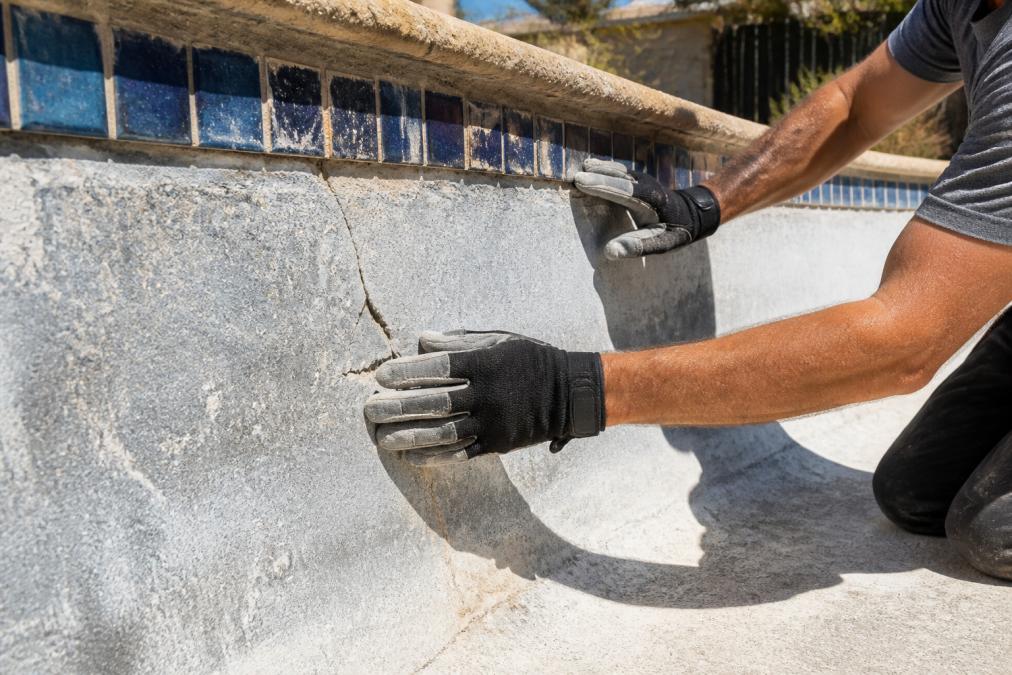
Structural repair is the single biggest variable in any older-pool budget, and the reason is chemistry, not cosmetics. A gunite or concrete shell is reinforced with a steel rebar grid. When water reaches that steel, through a hairline crack, a failed skimmer seal, or decades of minor plaster wear, the rebar oxidizes and expands. Rust occupies several times the volume of the original steel, so it pushes outward against the concrete from the inside (peer-reviewed research). That pressure is what produces concrete spalling: the shell surface flakes, pops, and eventually delaminates in chunks.
Once spalling starts, the failure accelerates. Exposed rebar corrodes faster, the bond between concrete and finish weakens, and the bond beam, the structural ring at the top of the shell that ties the walls together, can crack and separate. A cracked bond beam is the dividing line between a remodel and a rebuild, because it means the shell is no longer acting as a single rigid structure.
Soil movement compounds this. Expansive clay soils, common in many regions, swell when wet and shrink when dry, and that seasonal cycle flexes an older shell that was never designed for it (usgs.gov). Hydrostatic pressure from a high water table does the same from below, and if the pool has a hydrostatic relief valve in the main drain, a stuck or missing valve lets groundwater push up through the floor.
A common mistake is assuming a failing pool just needs new plaster. If the bond beam is compromised or the shell is shifting, resurfacing alone will crack again within a season. Leak detection and a structural inspection come first, always. A proper inspection looks for hollow spots (tapped with a hammer to hear delamination), rust stains bleeding through the finish, visible rebar, crack width and direction, and evidence of settlement around the deck and skimmer.
Plumbing and Equipment: What Aging Infrastructure Means for Your Budget
Plumbing retrofitting is where older pools quietly drain a budget. Original plumbing lines are often undersized, brittle, or leaking, and skimmer replacement may require cutting into the deck.
Older pools were frequently plumbed with a single suction line and a single return, sized for a single-speed pump that moved a fixed volume of water. Modern variable-speed and salt systems want more flow and more return points, so the existing plumbing can become the bottleneck. Common failure points include brittle PVC that cracks at fittings, galvanized or copper lines that corrode, and flex hose that collapses underground. A pressure test on the lines before the pool is drained tells you which runs hold and which need replacement.
Because these lines sit underground, the scope isn't fully known until the pool is drained and inspected. That's why honest contractors build contingency into an older-pool estimate rather than quoting a flat number up front. A reasonable planning range is to hold back a meaningful reserve specifically for underground surprises, and to treat any flat quote on a 20+ year-old pool with suspicion.
What Actually Drives the Number
When you strip away the finish choices, four variables move an older-pool budget more than anything else:
- Shell condition, cosmetic wear versus active spalling, rebar corrosion, or bond beam failure.
- Plumbing access, whether lines can be pressure-tested and reused or must be re-run under the deck.
- Equipment age and code compliance, whether the pad needs a full upgrade to meet current electrical and safety requirements.
- Deck and coping condition, whether the surrounding hardscape has to come out to reach the shell or plumbing.
A pool with sound structure and serviceable plumbing can be remodeled as a finish-and-equipment project. A pool with active spalling and failed lines is a construction project, and the price gap between those two scenarios is the single largest swing in the entire estimate.
Pool Resurfacing Cost: Plaster, Quartz, and Pebble Finish Options
Pool resurfacing cost depends mostly on the finish you choose, not the size of the pool. Plaster is the most affordable option, quartz sits in the middle, and pebble finish is the premium choice for durability.
Each finish changes how the surface feels, how long it lasts, and how it handles chemical balance:
| Finish | Relative Cost | Durability | Best For |
|---|---|---|---|
| Plaster | Lowest | Shortest lifespan | Tight budgets, quick refresh |
| Quartz | Mid-range | Moderate | Balanced value and looks |
| Pebble | Highest | Longest lifespan | Long-term durability, texture |
Plaster delivers a smooth, traditional look at the lowest upfront cost, but it wears fastest and needs the most careful water chemistry. Quartz blends crushed stone into the mix for better stain resistance and a longer life. Pebble finish, made from exposed aggregate, is the toughest and lasts the longest, which is why it costs the most.
Waterline Tile and Coping Replacement: The Cosmetic Costs That Add Up
Coping replacement and waterline tile are small line items that add up fast. Coping is the cap around the pool edge, and when it cracks or shifts, water gets behind it and damages the shell.
Waterline tile is the band at the water's surface that hides the scum line and protects the plaster edge. Replacing both is often necessary once the pool is drained for resurfacing, since doing it later means draining the pool again.
Pool Equipment Upgrade Costs: Pumps, Filters, and Automation
Pool equipment upgrade costs are the most predictable part of an older-pool remodel. The pool equipment pad usually needs a variable-speed pump, a modern filter, and often automation systems and LED lighting upgrade work. pool deck repair costs.
A common mistake is replacing equipment piece by piece as it fails. Upgrading the whole pad at once usually costs less in labor and prevents mismatched components that strain each other. If you're considering a salt-water conversion, the equipment pad is the right time to plan it, since the system ties into the pump and controls.
Variable-Speed Pumps and Energy Efficiency: Long-Term Savings vs. Upfront Cost
Energy efficiency is where an equipment upgrade pays you back. A variable-speed pump runs at lower speeds for most of the day, which cuts electricity use compared with a single-speed pump that only runs full blast.
The trade-off is real: variable-speed pumps cost more upfront, but the lower running cost typically recovers that gap over time. For a pool that runs year-round, the math favors the upgrade. Pair it with LED lighting and you cut another ongoing cost, since LEDs draw far less power than incandescent bulbs (energy.gov).
How Long Does a Pool Remodel Take? Timeline and Permitting Realities
How long does a pool remodel take? Most projects run several weeks from drain to refill, but the construction timeline depends on scope, weather, and the permitting process.
The permitting process is the part most homeowners underestimate. Many jurisdictions require permits for structural, plumbing, and electrical work, and inspections add days to the schedule. Structural repairs and decking renovation extend the timeline further, because concrete and finishes need curing time before the pool can be refilled.
A realistic sequence looks like this:
- Inspection, leak detection, and drain and clean
- Structural and plumbing repairs
- Resurfacing, tile, and coping
- Equipment pad upgrade
- Refill, balance, and startup
Rushing any stage, especially curing, causes failures later. Plan for the full timeline rather than the fastest case.
Renovation vs. New Construction: Which Makes Financial Sense?
Renovation usually makes more financial sense than new construction when the shell and plumbing are sound. You keep the existing excavation, which is a large part of what you'd otherwise pay to duplicate.
New construction wins only when the shell is beyond repair or the layout no longer fits how you use the yard. For most aging pools, a well-scoped remodel delivers the modern look and efficiency of a new pool at a fraction of the disruption. The deciding factor is structural integrity, not age alone.
Financing Options for Older Pool Remodels: Loans, HELOCs, and ROI
Financing an older-pool remodel often comes down to how you spread the cost, and the right tool depends on whether you're treating the project as a home improvement or a lifestyle purchase. The common routes:
- Cash-out refinance, replaces your existing mortgage with a larger one and gives you the difference in cash. Best when rates are favorable and you want one payment, but closing costs apply and you reset your loan term.
- Home equity loan, a fixed-rate second mortgage with a set payment and term. Predictable, and the interest may be tax-deductible if the funds are used to substantially improve the home, subject to current tax rules.
- HELOC, a revolving line of credit with a variable rate, drawn as needed. Useful when the scope is uncertain, which is common on older pools, because you only pay interest on what you draw.
- Personal loan, unsecured, faster to obtain, but typically a higher rate and shorter term. Reasonable for smaller cosmetic projects.
- Contractor payment plans, some builders offer staged payments tied to project milestones. Read the terms carefully; these are financing arrangements, not discounts.
A practical rule: match the financing term to the life of the improvement. A pebble finish that lasts 15-20 years can justify a longer-term loan; a one-time tile refresh probably shouldn't.
The ROI Question: Value-Add vs. Sunk Cost
The honest answer is that a pool remodel is not a dollar-for-dollar investment. What matters is separating upgrades that recover value from those that are purely for your enjoyment.
Upgrades that tend to recover value:
- Energy-efficient equipment. A variable-speed pump and LED lighting cut ongoing operating cost, and a buyer inheriting a pool with low utility bills sees that as a plus. This is the closest thing to a guaranteed payback in pool remodeling.
- Structural and safety repairs. Fixing spalling, rebar corrosion, and bond beam cracks isn't optional, an uninspected failing shell is a liability that can kill a sale or force a price concession. Money spent here protects value rather than adding it.
- Modern, neutral finishes. A clean, well-maintained surface and updated tile read as "move-in ready" and remove a buyer objection.
Upgrades that are largely sunk cost:
- Highly personalized features, custom water features, elaborate lighting scenes, specialty finishes in unusual colors.
- Over-improving relative to the neighborhood. A remodel that pushes the pool far beyond the surrounding homes' standard rarely returns the premium.
- Cosmetic-only changes on a pool with unresolved structural problems. You can't polish your way out of a failing shell.
The practical takeaway is to fund the structural and efficiency work first, because those protect the asset and lower operating cost, and treat the cosmetic layer as discretionary spending you're doing for yourself. A renovation budget built in that order recovers more value over time than one that starts with the visible upgrades.
For current pricing on your specific pool, request a quote from Palm Leaf Pools rather than relying on national averages, which rarely reflect local labor, permitting, and disposal costs.
Conclusion: Making a Smart Investment in Your Aging Pool
The challenge with an older pool is that the real cost lives beneath the surface, and guessing leads to surprise bills. Palm Leaf Pools handles the full scope, from structural repair and plumbing retrofitting to resurfacing and equipment upgrades, with clear communication at every stage. Our team keeps your pool clean, safe, and beautiful year-round while protecting your investment. Call today to schedule your remodel consultation.
Frequently Asked Questions
How much does it cost to redesign an existing pool?
Redesigning an existing pool typically involves resurfacing, new tile and coping, and possibly equipment upgrades. Costs vary widely based on pool size, material choices, and whether structural repairs are needed. For a standard inground pool, a full cosmetic remodel often starts in the low five figures, while structural repairs or plumbing retrofitting can push costs higher. Palm Leaf Pools recommends getting a detailed, itemized estimate that separates cosmetic work from hidden structural fixes.
Should older swimming pools be renovated or demolished?
Renovation usually makes sense if the pool shell and bond beam are structurally sound. Demolition is worth considering when the pool has extensive cracks, plumbing failures, or repeated leak detection issues that make repairs cost-prohibitive. A professional inspection can determine whether the pool shell can be saved. In many cases, modernizing an older pool with a pebble finish, variable-speed pump, and LED lighting upgrade costs less than new construction and preserves the existing footprint.
What are the most common hidden costs in older pool renovations?
Hidden costs often include structural repair to the bond beam, skimmer replacement, plumbing retrofitting, and decking renovation. Older pools may also need leak detection and repair before resurfacing. These issues are not always visible until the pool is drained and cleaned. A thorough pre-renovation inspection helps uncover these problems early. Budgeting a contingency of 15-20% above the initial estimate is a practical way to prepare for surprises.
Does pool remodeling increase property value?
A well-executed pool remodel can increase property value, especially in markets where outdoor living spaces are a priority. Upgrades like energy-efficient equipment, modern finishes, and automation systems appeal to buyers. The ROI depends on the local real estate market and the scope of the project. Cosmetic updates like resurfacing and new waterline tile tend to offer the most visible return, while structural repairs protect the investment by preventing bigger problems later.
How long does a pool renovation last?
The lifespan of a pool renovation depends on the materials and workmanship. A plaster finish typically lasts 5-7 years, while quartz and pebble finishes can last 10-15 years or more. Equipment like variable-speed pumps may last 8-12 years. Proper water chemistry and regular maintenance extend the life of any renovation. Palm Leaf Pools provides ongoing maintenance to help homeowners protect their remodel investment.
Is remodeling a pool worth it compared to building new?
Remodeling is often more cost-effective than new construction, especially when the existing pool shell is in good condition. You avoid excavation, permitting for a new structure, and landscaping restoration. However, if the pool has severe structural damage or outdated plumbing that fails repeatedly, new construction may be a better long-term choice. An experienced contractor can assess the pool shell and equipment pad to recommend the most economical path.